Site Utilities Construction in Texarkana, Texas
Water, sewer, storm drain, fire line and duct installation for commercial and industrial sites in Texarkana and Northeast Texas, built on clay and rain.
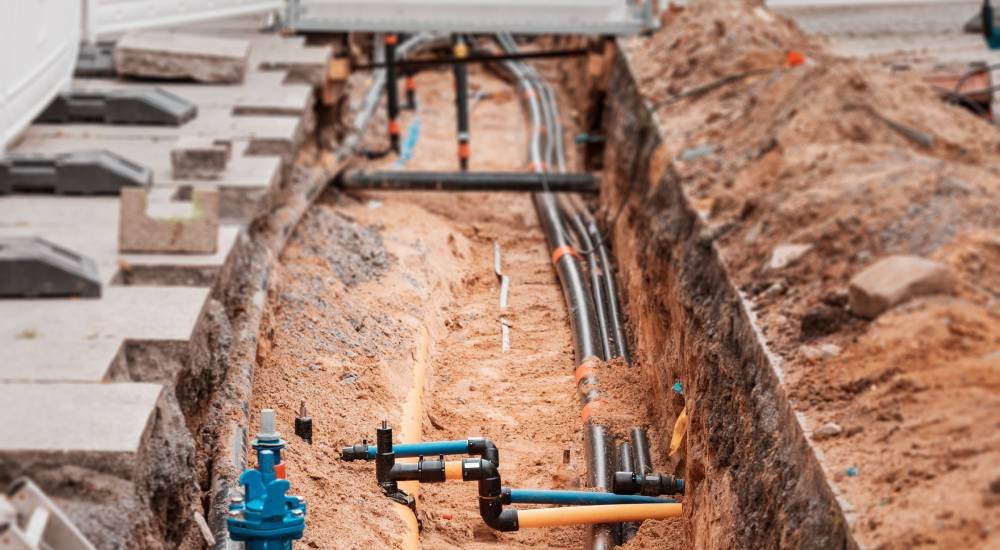
Nobody drives past a good water line and admires it, which is the point. Site utilities are the pipes, ducts, structures and trench backfill that sit under a parking lot and a slab for fifty years, and the only time anyone thinks about them is when something settles or leaks. We build them for general contractors, developers and industrial owners around Texarkana, and we take the buried work as seriously as the visible concrete on top.
The scope normally includes domestic water, fire service, sanitary sewer, storm drainage, electrical and communications duct, and the manholes, vaults and inlets that connect them. Each system has its own slope, cover, bedding, separation and testing rules, and each one has to fit around the others in a trench corridor that is rarely wide enough. On a typical commercial lot the work starts with a utility plan, a survey stake-out and a conversation about which line goes in first.
The way we do it comes from working on clay: we sequence the trench, protect it from rain, and place concrete over and around it in the right order, because we are also the crew that pours the slab. That gives us a habit most utility-only contractors do not have, which is thinking about what will sit on the pipe.
Where the work is coming from
The City of Texarkana plans to cluster light industrial, warehouse, flex and heavy industry uses south of Findley Street, where most existing industrial uses already sit. Utilities there serve older plants and the next generation of buildings, so new connections often tie into aging mains. West of town, TexAmericas Center announced that removal of the Army's permit by the Texas Commission on Environmental Quality opened more than 6,800 acres of shovel-ready ground, with a new onsite $200 million water treatment plant described as funded and soon to be under construction.
That kind of acreage turns into pads, roads and utility corridors, long before it turns into buildings. We bid land development infrastructure as well as single-lot utilities, and the demands are different. A long linear run is a pipeline job. A tight building pad with a dozen crossings is a coordination job.
Floodplain, soils and the water table
The 2024 Hazard Mitigation Plan notes that parts of Texarkana, mostly following waterways, lie in the 100-year floodplain. The city requires a floodplain permit reviewed by the City Engineer. For utilities, that means a line crossing a drainage way needs approvals, and the trench has to stay stable when water is moving through it. Impaired streams such as Swampoodle Creek, just east of downtown, add environmental review to some crossings.
Soils shift the plan again. Upland soils in the Texarkana area are mostly sandy and loamy over clay subsoils, with red clay in areas of redlands. Sandy surface layers can cave in a trench wall, while clay holds a vertical cut for a time and then fails suddenly. We shore or slope according to the soil we see, not the soil the report predicted, and a competent person is on site every day a trench is open.
Sequence, bedding and backfill
We stake the lines, locate and pothole existing utilities, then excavate only as much trench as the crew can lay and cover the same day. Bedding is placed to the pipe manufacturer and engineer's requirement, the pipe is laid to grade with a laser, and backfill is compacted in lifts with density tests. Skipping lifts to finish faster is the single most common cause of settled pavement over a utility cut.
Where a trench crosses a future slab or pavement, we think about flowable fill, trench plates, and the order of subgrade work. The water main installation and sanitary sewer installation trade crews use that same discipline, with slopes checked at every manhole.
Permits, inspections and testing
Utility work inside Texarkana city limits goes through the city, and the Inspections office at 220 Texas Blvd posts the plumbing, fire and electrical codes it enforces. A third-party permit guide reports no county-issued general building permit requirement for Bowie County, with septic as the exception, so unincorporated sites should be confirmed with the Bowie County Commissioners Court. We never assume.
Testing is part of the contract: pressure tests on water and fire lines, air or vacuum tests on sewer, mandrel checks where required, and video inspection when the engineer asks. We schedule inspectors ahead of backfill, since a failed test after backfilling doubles the cost of the repair.
How utilities connect to the rest of the job
Utilities rarely stand alone. A pad that receives a new building needs storm drain installation to carry roof and pavement water, electrical duct banks for power.
Most buildings also need fire line and hydrant installation before a certificate of occupancy is possible. We schedule all of these as one package so the trench crew does not return three times.
When the utilities run under truck routes, we coordinate with the pavement crew so that structures such as manholes and inlets are set to final grade at the right time. Manholes and vaults set too high or too low are the first thing a trucker or a plow finds.
Who we build for
Our biggest clients here are industrial and manufacturing owners, whose plants depend on reliable water, process drainage and power. Municipal and public works clients need the same quality with more documentation. Developers want a compact schedule and a price that does not move.
For depot-area and TexAmericas Center work, we also talk about the TexAmericas Center campus layout, rail spurs and former military utility corridors, because buried legacy lines are a real hazard on land with a long history of use.
Get your utility package priced
Send the civil drawings and we will give you one price for every buried system, with the sequence and testing plan spelled out. Call or use the quote form.
Common Questions
What order do utilities go in on a new building pad?
Usually the deepest gravity lines first, which means sanitary sewer and storm drain, then water and fire service, then electrical and communications duct. The crossings decide the details. We draw the crossings on the utility plan before the trench opens, so no one cuts a shallow line to get at a deeper one.
How do you handle wet weather during trenching?
We keep the open length short, pump water from the trench bottom, and leave bedding material ready so it can be placed as soon as the trench is dry enough. Annual rainfall in this region runs 42 to 58 inches, so we plan on delays rather than hoping to avoid them. Backfill is not placed into standing water.
Who is responsible for locating existing lines?
Texas requires a locate request before digging, and we place it. Locate marks are only the first step, so we pothole critical crossings to confirm depth and material. Old industrial and depot-area ground can contain lines that are not on any current plan.
Do you do the connections to city mains?
Yes, though the city or utility sets its own requirements for tap and tie-in work, including inspection and sometimes who performs the physical connection. We find out those rules in the early permit phase and include them in the schedule.
What causes utility trenches to settle under pavement?
Poor compaction, wet backfill, skipped lifts and organic material left in the fill. Clay makes it worse because it shrinks and swells around the trench. We test density in each lift, and for trenches under heavy pavement we often use flowable fill to close that risk.
Can you work in or near a floodplain?
Yes, with approvals. The City of Texarkana requires a floodplain permit reviewed by the City Engineer. We prepare the sediment control, the construction sequence and the restoration plan the reviewer expects, and we keep equipment out of the channel.