
Concrete and Sitework at TexAmericas Center
Rail-served slabs, building pads, utilities and mass grading for owners and developers at TexAmericas Center west of Texarkana, Texas.
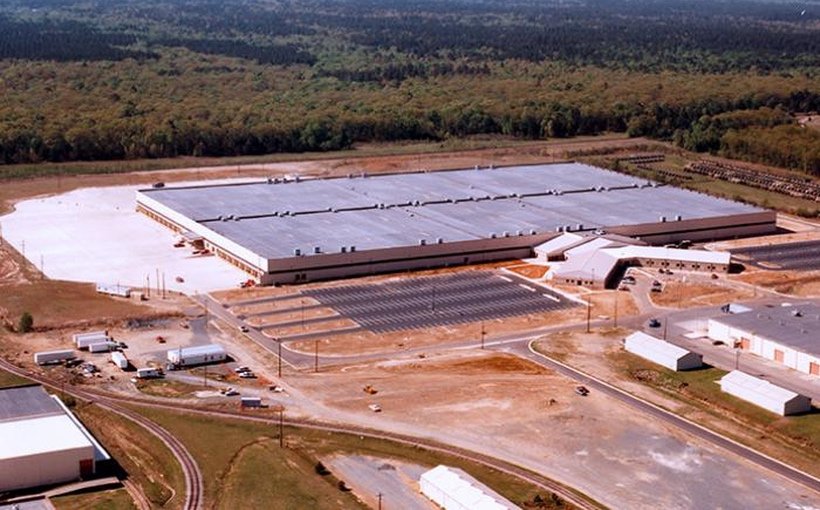
Big sites need big earthwork before any concrete is placed, and TexAmericas Center is a big site. The park is roughly 12,000 acres of former military land in Bowie County west of Texarkana, with an East Campus of about 8,867 acres and a West Campus of about 2,850 acres, according to a June 2026 local news report. For an owner or tenant looking at a lot there, the questions we answer are practical: how much of the ground is ready to build on, how do trucks and rail reach it, and what does it take to get a slab, a pad and a utility corridor in place.
The land has a long industrial record. The Army's base-closure page for the Lone Star Army Ammunition Plant says the facility sits in Bowie County 12 miles west of Texarkana, began with 15,588.85 acres of which 14,291.87 were conveyed, and had over 2 million square feet of space split between storage and production. In April 2021 the park announced that removal of the Army's RCRA permit by the Texas Commission on Environmental Quality opened more than 6,800 acres of additional shovel-ready ground. Environmental history is a fact of life on a site like this, so we start every job by asking for the owner's environmental and geotechnical records and by following any excavation protocols the park requires.
We describe announced projects the way they were reported and nothing further. We make no claim about who builds what at the park; we say what concrete, utility and earthwork scopes tend to come with these kinds of buildings, and what we would ask before pricing them.
Rail-served slabs, pads and yards
The park's rail provider lists 38 miles of track on the East Campus and 100 rail-served acres on the Central Campus, with transload, storage and spotting services from the Texas Northeastern Railroad. A rail-served building has a different slab than a truck-only one. The dock side may see both trucks and rail-car spotting, the yard may include transload pads, and the track crossings need heavy-duty concrete or panels set to the railroad's standards. We coordinate the subgrade and the finish elevation with the track so an apron meets the rail head within tolerance.
Typical scopes here include building pad preparation, thick industrial slabs, truck courts, equipment foundations and secondary containment for process areas. Where chemicals are stored or processed, containment pads need sealed joints and curbs that match the permit. We price and schedule these with the building rather than as an afterthought.
Announced projects that shape the work ahead
A few recent announcements show the range of buildings that land at the park. A 150,000 square foot multitenant spec building on 24 acres, completed December 22, 2021, offered 32 foot clear height, one dock door per 5,000 square feet and two drive-in doors, and could be divided to units as small as 13,000 square feet. A governor's announcement on February 13, 2025 described an advanced recycling facility at the park with more than $145 million in capital investment, and a June 17, 2026 report described an expected $50 million expansion by a specialty chemical manufacturer adding about 100 million pounds of annual capacity.
Each is a different kind of concrete. A multitenant distribution building wants a flat, jointed floor and long dock aprons. A chemical plant wants chemical-resistant slabs, containment and rail-side pads. A planned power-intensive campus announced in April 2026, Project Big Pine, was described as a 500-acre data center campus with an estimated $3.5 billion in projected investment and a 24 to 30 month target to energize (other outlets cite 400 or 450 acres), and would involve data center equipment pads and duct banks. These are announcements, and we treat them as such.
Haul distances, batch plants and the long lead items
The park lies about 12 miles west of Texarkana, so ready-mix trucks travel a meaningful distance. We plan pour sizes around the batch plant's cycle time and the drive, add retarder in hot weather, and keep trucks moving through the site on marked routes. For big placements we confirm trucking capacity the week before, because a half-day shortfall in trucks can produce a cold joint in a floor that cannot have one.
Access from US 82 and the surrounding highways is part of the picture; our page on the US 82 corridor describes the widening plans on that road. Earthwork usually leads the schedule, so we line up mass grading and utility trenches first, then concrete, and then paving, with weather days built into every phase.
Where the money goes on a large industrial pad
At this scale, earthwork and utilities typically cost more than the slab itself. The park announced a new onsite $200 million water treatment plant as funded and soon to be under construction in April 2021; whether you are served by that plant or by on-site lines, we price water, sewer, fire and storm lines together so that you see the full cost to deliver a ready pad. Rock, wet pockets and fill from prior uses are the unknowns, and we carry them as unit-priced allowances.
Power is another driver. Heavy-load buildings often need substantial electrical service, and we build the electrical duct banks with concrete encasement, spacers and pull strings to the utility's standard. Planning duct banks and manholes early avoids cutting new floors later.
Who we talk to about TexAmericas Center
Our conversations come from logistics and warehouse developers and industrial and manufacturing owners, plus general contractors who need a concrete and sitework partner. A June 2026 local report said roughly 30 companies operate at the park employing more than 1,000 people, while coverage of the January 2026 annual report counted 44 companies, 1,536 jobs created and 1.4 million square feet of industrial and commercial space in use; the figures differ, so we cite them only as a sign of activity.
Our nearby Red River Army Depot page covers a separate federal installation. We keep the two apart, because their rules, owners and access procedures are not the same.
Start with the parcel
Tell us the parcel, the building and the rail or utility needs. We will review the available soil and environmental records, price pad preparation and concrete together, and map the haul and pour plan.
Common Questions
How do you price a site with no completed survey or soil report?
We price with allowances and clearly stated assumptions, then convert to firm numbers when the geotechnical and survey data arrive. For a park of this size, we usually ask for borings at each building corner and at major pavement areas, because soil changes quickly across several thousand acres.
Can you build rail-served slabs?
Yes. We coordinate the finished slab elevation, dock apron slope and track crossings with the railroad's requirements and set embeds for spotting equipment where the design calls for them. Rail-side pours are scheduled around train movements.
What about environmental history on former ordnance land?
We ask for the owner's environmental records at the start and follow any excavation, stockpile and disposal protocols the park or regulators set. If we find an unexpected condition, we stop, document it and notify the owner before going further.
Do you handle the utilities and the concrete together?
We do. One coordinated scope can cover trenching, pipe and duct bank installation, backfill and slab placement, with protected handoffs between trades, giving you one schedule and one set of tests.