
Water Main Installation in Texarkana, Texas
Water main installation for commercial and industrial sites near Texarkana: trench and bore, bedding, restraint, flushing, disinfection and pressure testing.
Water for Texarkana comes in part from a reservoir that was built for flood control first. Wright Patman Lake covers 18,247 acres at conservation pool, and the Corps lists 77,300 acre-feet of conservation storage set aside for municipal supply. Everything a new development gets from that system arrives through a main, and the quality of that main depends on trench work done years earlier by someone like us.
Water main installation is more than laying pipe in a ditch. It covers the stake-out, the trench or bore, bedding, joint assembly, thrust restraint at fittings, valves, services, flushing, disinfection, pressure testing and tie-ins to the live system. The most important part is the one you cannot see after backfill: restraint at bends and tees, and bedding that supports the pipe without voids.
We install domestic and fire service mains for commercial sites, subdivisions and industrial parks, and we hold the contract through testing and acceptance. This is what we plan, how we sequence it on Northeast Texas ground, and what affects your price.
What the scope includes
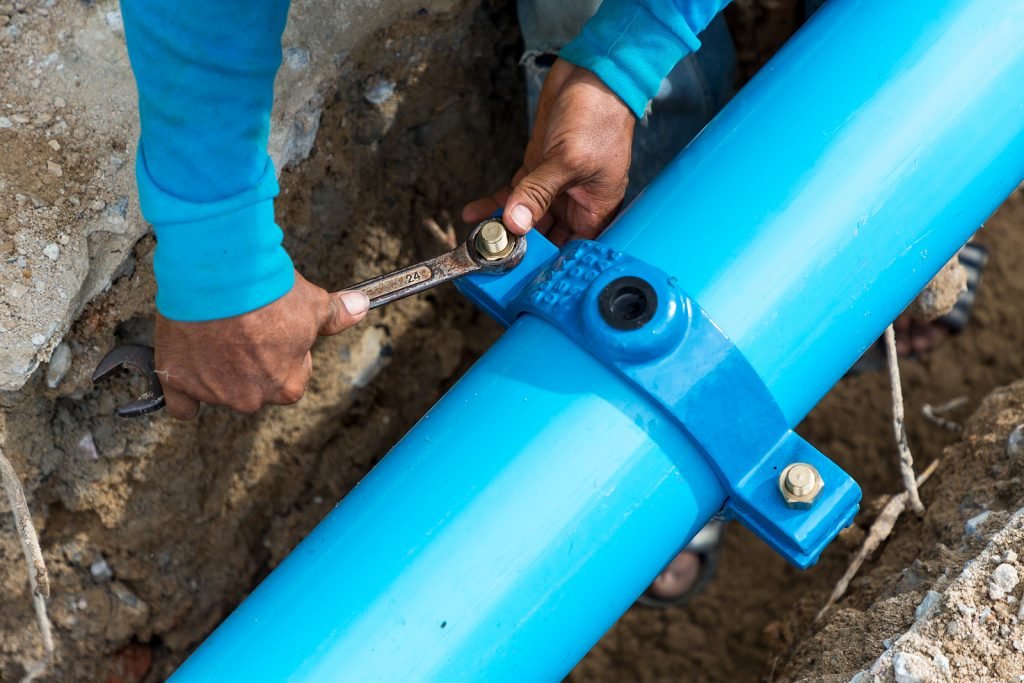
A typical main extension runs from a tie-in point at an existing line to the new site, with gate valves at intervals, hydrant assemblies, and service stubs for each building. Pipe is normally PVC or ductile iron depending on the utility's standard, with tracer wire and warning tape for later locating. Fittings get thrust blocks or restrained joints, since a pressurized line at a bend wants to move.
The scope often includes connections under a road, by open cut or by boring. Open cut is cheaper but disrupts traffic and requires pavement restoration. Boring avoids that on major streets, though it adds equipment and needs a clear exit pit. We price both and let the owner choose with the numbers in front of them.
Reading the ground along the route
In the Hooks area the ground sits at 371 feet, and in Nash it sits at 361 feet. Water follows that gentle fall after storms. A trench cut across a slope collects runoff, so we place dewatering and erosion control with the trench, not after it. The route is also usually shared with other utilities, so the first thing we do is pothole every crossing before we dig a foot of new trench. We also walk the route after the first hard rain, because a swale that looked dry in the survey can turn into a channel across the trench line, and we would rather move a spoil pile than fight a washout in the middle of a pipe run.
Clay is the other consideration. Trench walls in clay look stable until they are not, and wet clay under a pipe is a bad bed. We over-excavate soft spots and place compacted granular bedding, and we keep bedding material dry and ready ahead of the pipe. When the ground is too saturated to work, we stop rather than bury a problem.
Laying pipe so it passes first time
The pipe crew works from the downstream end to the upstream end of a section, checking grade at each joint with a laser. We keep trenches short, set valves and fittings as we go, and restrain every joint the drawings call for. A day's work is closed with the pipe end capped so debris and runoff cannot get in.
Once a section is complete, we flush it, disinfect it to the utility's procedure and take samples. Only then do we pressure test. A pressure test on a clean, restrained main is a formality. On a poorly bedded one it is an expensive search for a leak. Our site utilities planning keeps this work in a continuous order so the same trench is not opened twice.
Standards, permits and acceptance
Water mains serving public systems follow the utility's standard details and the state's drinking water rules, and the utility inspector must be present for the pressure test and often for the disinfection sampling. For private mains on commercial property, the engineer's plans and the city's plumbing and fire provisions apply, and the Inspections office is the place to check which edition is in force. The edition in force should be confirmed with the City.
We keep records of every test: dates, pressures, durations and witnesses. Those records are what let an owner or a city accept the line without a second trip, and they are part of the closeout binder we hand over.
What drives water main cost
Pipe size and material come first, then trench depth, rock or hard ground (rare locally but possible), surface restoration and the number of fittings. A main in an open field with few crossings costs far less than a short run in a crowded street, and a long run with one difficult crossing can cost more than the rest of the pipe put together. Traffic control, night work and city-mandated pavement repair add to cost on public streets.
Schedule risk is a cost too. Utilities that must shut down a main to allow a tie-in typically require notice, and a customer outage window may only be available at night or on a weekend. We build that into the schedule and the price, so it is not a surprise.
Pieces that travel with a water main
Water mains rarely go in alone. Fire line and hydrant installation takes its water from the same system and has its own testing. Utility potholing and locating comes first.
Once rain arrives, dewatering is what keeps the trench workable.
New customers in town are growing as well; Nash grew from 2,169 residents in 2000 to 3,814 in 2020, and each new household or business adds demand to the lines we extend. Municipal and public works clients should expect us to design the installation for the next phase of extension, not only the present one.
Price your water main extension
Send the utility plan and the tie-in location. We will return a price that separates open cut from bore, shows testing, and states the outage window we need.
Common Questions
How deep does a water main need to be buried?
The utility's standard sets minimum cover, and it also depends on what crosses the line, such as a road or ditch. In this area cover is mostly about protecting pipe from traffic loads and avoiding conflicts with other utilities. We follow the plans and confirm depth at every crossing.
Open cut or bore under a road?
Open cut is lower in cost and works for lightly used streets with permission to close them. Boring suits arterial roads, railroads and drainage ways where closing is not possible. The deciding factors are traffic, depth, soil and what else is buried there.
How long does testing and disinfection take?
A typical section needs a day or two between flushing, disinfection, sampling and lab results. The lab turnaround is what controls it. We schedule tie-in only after the utility accepts the sample, and we do not let site work depend on a date that the lab has not confirmed.
What if we hit an unmarked line?
We stop, secure the area and call the owner of the line, then document what we found. Pothole confirmation reduces this risk but does not remove it, especially near the former military installations west of town where old utility records may be incomplete.
Can water mains be installed in a flood-prone area?
Yes, with attention to the route. The line may need extra cover, sealed joints and valves above the flood level, and it may need a floodplain review. We also avoid leaving open pipe ends that could draw in floodwater during construction.