About Concrete Contractors of Texarkana
Commercial concrete in Texarkana, Texas
We plan the site, the schedule and the approvals before the first truck arrives, and keep the trade partners, testing and inspections on one plan.
How We Work
Most of the concrete we place in Northeast Texas is never looked at again. It sits under a forklift aisle, a truck court or a parking lot, and if it was built right nobody thinks about it for decades. Concrete Contractors of Texarkana is set up to build that kind of work: foundations, slabs, flatwork and paving, the underground utilities that run beneath them, and the grading and excavation that come first.
We work Texarkana, Texas and the surrounding Bowie and Cass county towns. The ground here decides a great deal, so we start with the ground and finish with the finish. We care about subgrade, curing and joint layout more than the pretty surface, and we say so to every owner and general contractor who calls.
What we build
The scope runs in three layers. The first is earthwork: clearing, stripping, mass grading, cut and fill, building pad preparation, engineered fill and soil treatment with lime or cement. The second is the buried work, where we handle water, sanitary sewer, storm drain, fire line, duct bank and conduit trenching, along with manholes, vaults, culverts and detention basins. The third is the concrete itself, from footings, stem walls, grade beams and drilled piers to slab on grade, industrial floors, dock aprons, truck courts, curb and gutter, sidewalks and accessible routes.
Holding all three layers under one roof matters because they depend on each other. A slab is only as good as the pad beneath it, and a pad is only as good as the trench backfill that crosses it. When one crew grades, another trenches and a third pours, the finished floor is where the handoffs show up as settlement and cracks. We would rather coordinate the whole sequence, so that the person who cares about the slab also decides how the subgrade gets proof rolled.
If you need a general overview of how we handle larger projects, our page for a commercial concrete contractor walks through permits, plan review and the way we sequence a job around an owner's schedule. If your project is mostly dirt and pipe, start with site utilities instead.
The clay comes first
Anyone who has dug in Bowie County knows the soil. The USDA series description for the Billyhaw soil, whose type location is at Texas Highway 8 and Interstate 30 in New Boston, calls it a very fine clay with 60 to 80 percent clay on Red River flood plains, moderately well drained with very slow permeability. The nearby Texark series is described as a very fine smectitic clay that cracks open when dry and has an apparent water table within a few feet of the surface. That is blackland clay, and it moves. It swells when it drinks and shrinks when it dries, and a slab that was poured over it without a plan will tell you about it within a couple of seasons.
Rain adds to the problem. The Texas Almanac lists Bowie County at 52.0 inches of rainfall for 2019 and Cass County at 49.2, which means rain delays are a normal part of the schedule and not a surprise. A red clay haul road that was fine on Monday can be a trench of soup by Thursday. We plan for that by staging stone, controlling drainage early and keeping the building pad crowned and sealed when a front is coming.
We keep a longer write-up on what the clay does in Bowie and Cass counties, and it is worth reading before you finalize a budget. When the soil report calls for it, the fix is usually over-excavation and recompaction, lime or cement treatment, or a structural foundation such as a post-tensioned slab or drilled piers. We ask for the geotechnical report on every job. Where there is none, we recommend borings before design is final, because a few thousand dollars of testing is cheap next to a floor that curls.
How a job runs
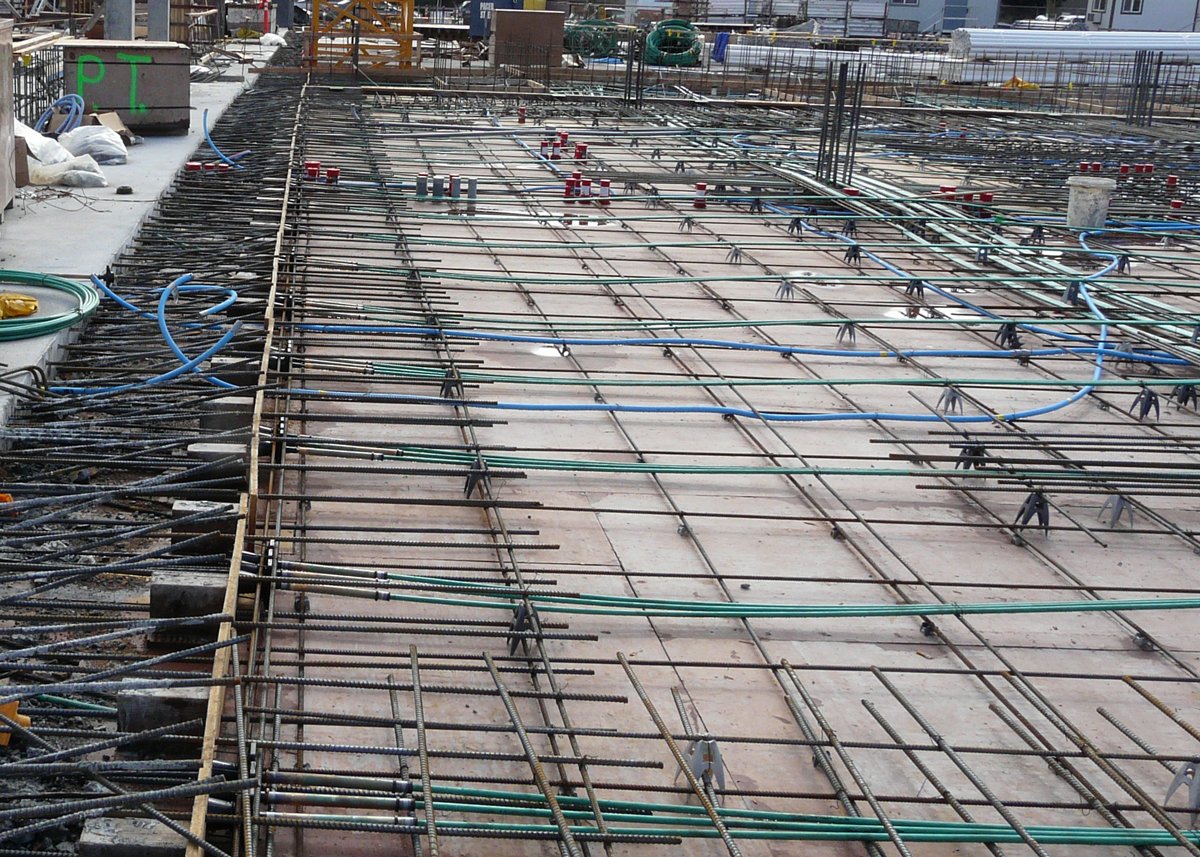
Our process is plain and it is the same on a small pad as on a large floor. We walk the site, read the plans and the soil report, and ask about access, utilities and the owner's schedule. We price the work in pieces so that earthwork, pipe and concrete can each be understood. Then we sequence it so that the pad is proofed before forms go up, the rebar is chaired and inspected before the truck arrives, and the pour day is set for weather that cooperates.
On pour day we watch slump, temperature and the clock. We place, strike off, float and finish at a pace the mix allows, and we get curing started early, with blankets, compound or wet curing depending on the season. Joints get laid out before the pour, not guessed at afterward, and they are sawn while the slab can still take a clean cut. Cold mornings and hot, windy afternoons each change how we protect the concrete, and we adjust instead of pushing through.
Permits and codes in Texarkana, Texas
Building codes in Texas are adopted and enforced locally, so the first stop for most work inside the city is the Inspections office at 220 Texas Blvd, Municipal Building, Room 301. The City's inspections page lists the International Building Code as presently in use, and plans must also meet the Texas Accessibility Standards administered by the Texas Department of Licensing and Regulation. The edition in force should be confirmed with the City. We do not guess. We confirm the edition in force with the Inspections Department before a drawing set is priced, and we suggest owners do the same.
Outside city limits the picture changes. A third-party permit guide reports that Bowie County does not issue general building permits and lists septic as the county exception, so work in Nash, Wake Village and the unincorporated areas needs to be confirmed with the right office. We help our customers sort that out early, because a permit question discovered on pour day costs a week.
Who we build for
Our customers are general contractors, developers, industrial owners, public works departments and utility companies. The Texarkana economy runs on a mix that shapes our work: military and defense maintenance, distribution, healthcare, education and manufacturing. Each of those wants something different from a slab.
A distribution tenant wants a flat, jointed floor and a dock apron that does not break at the leveler. For warehouse and logistics developers, we build the whole package, from pad to truck court, and we usually recommend reinforced concrete in the truck court because trailer landing gear destroys asphalt. A hospital or school owner wants work that goes in quietly, on schedule and without surprises for the occupants next door. A municipality wants curb, gutter, sidewalks and storm drainage that meet the standard and last.
Specialty buildings bring their own concrete. A aircraft hangar needs a floor that is flat under an aircraft, drainage that meets the fire protection rules and a foundation that carries a door opening a hundred feet wide. Nothing in our research points to an announced vehicle and battery plant in Bowie County, and we would rather say so than invent one. If one is announced, the work is familiar: many acres of mass grading, treated and tested fill, deep foundations and heavy floors.
Where we work
Our home market is Texarkana, Texas, along Interstate 30, the Interstate 369 and U.S. 59 corridor, and U.S. 82. From there we reach the surrounding Bowie County towns of New Boston, Hooks, Nash, Wake Village and Leary, and into Cass County at Atlanta, Queen City, Linden, Hughes Springs and Naples, with Maud, DeKalb and Omaha in between. Industrial land around Texarkana is clustered south of Findley Street, and newer sites open up west of town.
West of Texarkana, two large properties draw a lot of attention. TexAmericas Center is roughly 12,000 acres of former military land in Bowie County, with a rail provider that lists 38 miles of track on the East Campus. Any building there needs a slab designed for either truck or rail service, and a great deal of earthwork before any concrete. Red River Army Depot occupies over 15,000 acres and more than 1,400 buildings, according to the Army, and old floors inside working buildings are a different kind of concrete problem. We describe the conditions on both properties as the public record gives them. We do not claim contracts at either one.
How we think about the work
We do not decorate. Our attention goes to the parts of a concrete job that decide whether it lasts: a firm and uniform subgrade, enough reinforcement placed where it belongs, a mix that suits the day, joints in the right places and curing that does not quit early. Those items rarely show up in a photograph, but they decide whether a floor is still flat in ten years.
Whether you are a developer pricing a spec building, a general contractor who needs a coordinating partner for the foundation and site package, or an owner with a failed floor and a deadline, send us the drawings and the soil report. We will tell you what we would build, what it takes and what could change the number.
Common Questions
Do you handle the dirt work and the concrete on the same job?
Yes. We perform clearing, grading, utilities, excavation and the foundations, slabs and paving as one coordinated package, so the subgrade, the trenches and the concrete are planned together instead of passed between crews.
Which areas do you serve?
We serve Texarkana, Texas and the surrounding Bowie and Cass county towns, including New Boston, Hooks, Nash, Wake Village, Leary, Atlanta, Queen City and Linden, along the Interstate 30, Interstate 369 and U.S. 82 corridors.
Why does the soil matter so much for a slab here?
Bowie County has very fine clay that swells when wet and shrinks when dry. A slab on poorly prepared clay can heave or crack, so we review the geotechnical report and prepare the subgrade to match what the engineer recommends.
Which building code applies to my project in Texarkana, Texas?
Codes are adopted locally. The City's inspections page lists the International Building Code. The edition in force should be confirmed with the City. Confirm the edition in force with the Inspections Department before pricing.
Can you build a floor for a rail-served or heavy-truck building?
Yes. Rail-served and heavy-truck buildings need reinforced slabs, carefully laid out joints and strong dock aprons and truck courts. We design the pour sequence around those loads and the traffic they bring.
Project Review
Plan your Texarkana concrete project
Send the site, the scope and the target date. We will set up a review of schedule, permits and inspections.