
Electrical Duct Banks in Texarkana, Texas
Concrete-encased electrical duct banks for industrial, healthcare, municipal and utility sites in Texarkana and Northeast Texas, built to be pulled years later.
Power-hungry projects are coming to Bowie County, and every one of them depends on conduit in concrete under the ground. A planned 500-acre data center and power-intensive campus at TexAmericas Center, announced in April 2026 with an estimated $3.5 billion in projected investment, cites a nearby 345-kV transmission line, natural gas, a water solution and high-capacity fiber. Those announcements describe plans, not finished buildings, and what they all need first is a way to move electricity safely across a site.
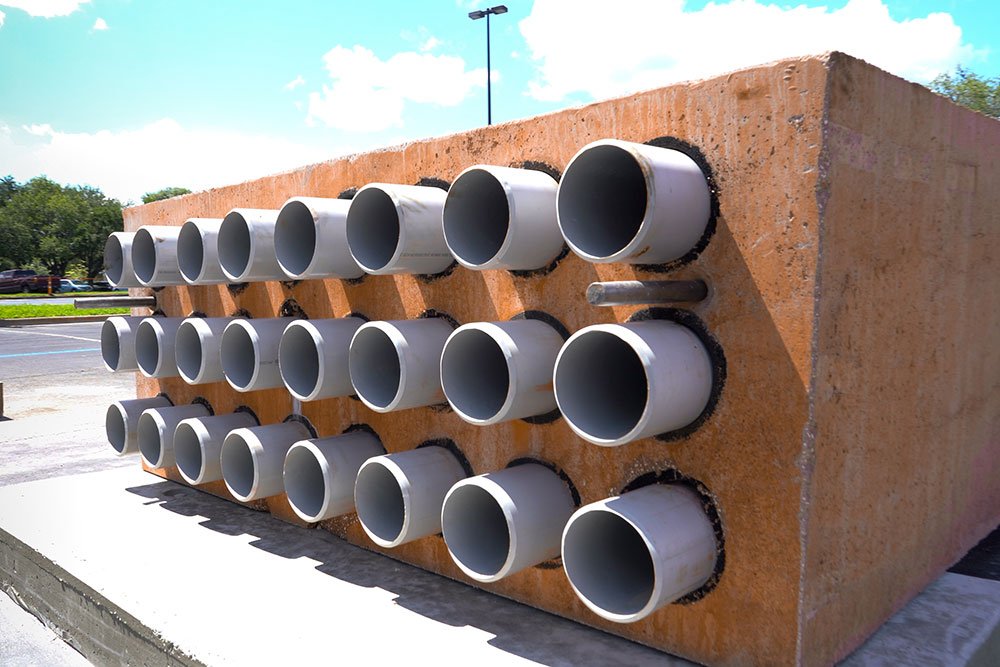
An electrical duct bank is a group of conduits encased in concrete, buried at a set depth, with pull boxes or manholes at intervals. The concrete protects the conduit from digging, traffic and ground movement, and it keeps the pipes in a fixed arrangement so that spacing and heat dissipation work as designed. It is a quiet piece of infrastructure, and it is almost impossible to correct after the fact.
We build duct banks for industrial plants, healthcare campuses, schools, municipal buildings and utility-driven projects, and because the work is half excavation and half concrete, it sits squarely between the two sides of our company.
What goes into a duct bank
The scope starts with the trench, cut to the width and depth the drawing calls for, with a level bed. Conduit is assembled in groups with plastic spacers that hold each pipe the required distance from the next, and the spacers are tied or weighted so they do not float when concrete is placed. Rebar is added where the engineer requires it, particularly at crossings and under roads.
Concrete is placed around the conduit in a controlled way, from one end, so it flows around the pipes without displacing them. Many duct banks use colored concrete or red dye as a warning to future diggers. Pull boxes, handholes and transformer pads are set at the planned locations, and a mandrel is pulled through every conduit before the bank is accepted.
Heat, spacing and rain on a trench
Cable gives off heat, and a duct bank has to let it out. Spacing between conduits and the thickness of concrete cover are calculated for thermal performance, which is why we do not substitute spacers or squeeze conduits closer to save trench width. Depth matters too, as does the soil: dry clay and wet clay carry heat differently.
Rain is a practical concern. Concrete placed into a trench that is filling with water loses strength and displaces conduit. We pump the trench, place a seal of lean concrete or stone when needed and cover finished sections the same day. The annual rainfall in the Piney Woods area runs 42 to 58 inches, and a plan that ignores it will not hold.
Building a bank that cables can be pulled through
The test of a duct bank is whether cable can be pulled through it years later. That depends on straight runs, smooth sweeps at bends, clean joints and no concrete inside the pipe. We cap every end, glue every joint to the manufacturer's rules and pull a mandrel and a rope before covering. Skipping this last step is how a bank becomes a pile of useless pipes.
We also record locations. As-built survey of the duct bank, with depth at every changing point, is part of our closeout. When a future crew has to locate utilities before an excavation, those as-builts are what keep them from damaging a live feeder.
Utilities, industry and public owners
Work for utilities and energy companies follows the owner's own standards for depth, concrete strength, markers and testing, and we build to those standards without argument. Industrial owners are different: they often want the duct bank to be coordinated with process piping, which means the trench is shared and the sequence is tight.
At TexAmericas Center, an advanced recycling facility was announced in February 2025 with more than $145 million in capital investment under the Texas JETI program. A facility like that needs power distribution across the site, and a duct bank is the foundation for it. Our TexAmericas Center experience is in this sort of heavy industrial yard.
Facilities that need banks
Mission-critical buildings, including data centers, depend on redundant feeds in separate banks, and the separation distance between them is a design requirement. Manufacturing plants need banks to feed production lines, welding equipment and large motors, and often have future-expansion conduits stubbed out and capped.
A contract at Red River Army Depot for an advanced automation manufacturing initiative, valued at $39.2 million initially, shows the kind of project where existing buildings gain new power loads. Upgrading feeders at a campus with more than 1,400 buildings means working among old structures, and potholing comes first.
Code references and inspection
The City of Texarkana, Texas Inspections page lists the National Electrical Code among the codes the city presently operates under, and the electrical inspector reviews underground work before it is covered. We confirm the electrical code edition at the start of each project. Utility-owned facilities follow the utility's own construction standards and inspection.
We schedule inspection before pour, not after. An inspector who sees conduit, spacers, separation and depth in an open trench can approve in minutes. An inspector who is called after the concrete is placed has nothing to look at but our word, and cannot accept it.
Where cost builds up
Conduit count and diameter drive material cost, but labor drives more: the number of bends, the length of each pull section and the time needed to assemble spacers. Concrete volume rises quickly as banks grow, and rebar adds to it. Crossings of roads, drainage ways and other utilities need extra work.
Restoration is often the biggest unknown. A trench through a parking lot or a landscaped area has to be put back, and the owner usually wants it to look as it did before. We carry restoration as its own line so the electrical scope and the surface scope can be compared separately.
Coordination with fiber and relocation work
Power and communications are usually designed together. The conduit and fiber trenching trade crews often share the corridor, with separation between the two as the code requires. If the route crosses an existing line that must be moved, utility relocation becomes part of the plan.
The equipment for large loads sits on equipment pads and machine foundations that we pour to match the manufacturer's template, and we set the pad and the first pull box together so the conduit stubs land exactly where the gear will sit.
Plan your duct bank route with us
Send the electrical site plan and the one-line diagram. We will propose a trench route, a pour method and a price that includes mandrel testing and as-built survey.
Common Questions
How deep should an electrical duct bank be buried?
The National Electrical Code and the utility's standards set minimum cover that depends on voltage and what is above the bank. Roads and heavy traffic call for more cover or additional protection. We build to the engineer's drawing and verify depth with survey during construction.
Why is the duct bank encased in concrete?
The concrete protects conduit from damage during later digging, holds the pipes in place so that spacing remains correct, and in some designs improves heat transfer. Red-dyed concrete also warns future excavators.
Can you work around existing underground lines?
Yes, by locating them, potholing to verify depth and hand-digging near them. Ground that has served industrial and military users for a long time can hold lines not shown on current drawings, so we proceed carefully.
What does a duct bank cost per foot?
It varies widely with conduit count, trench depth, concrete volume, reinforcing, crossings and restoration. A four-way bank in open ground costs far less than a twelve-way bank beneath a road. We price by the foot with separate lines for crossings and structures.
How do you keep conduit from floating in the concrete?
With spacers, tie-downs and a controlled pour sequence. We place concrete in lifts and check alignment as we go. Heavy rain makes this more difficult, so we do not place into a flooded trench.