
Concrete Contractor in Downtown Texarkana, Texas
Infill footings, slabs, sidewalks and accessible routes in downtown Texarkana, Texas, with floodplain, code and rain-delay planning built into each pour.
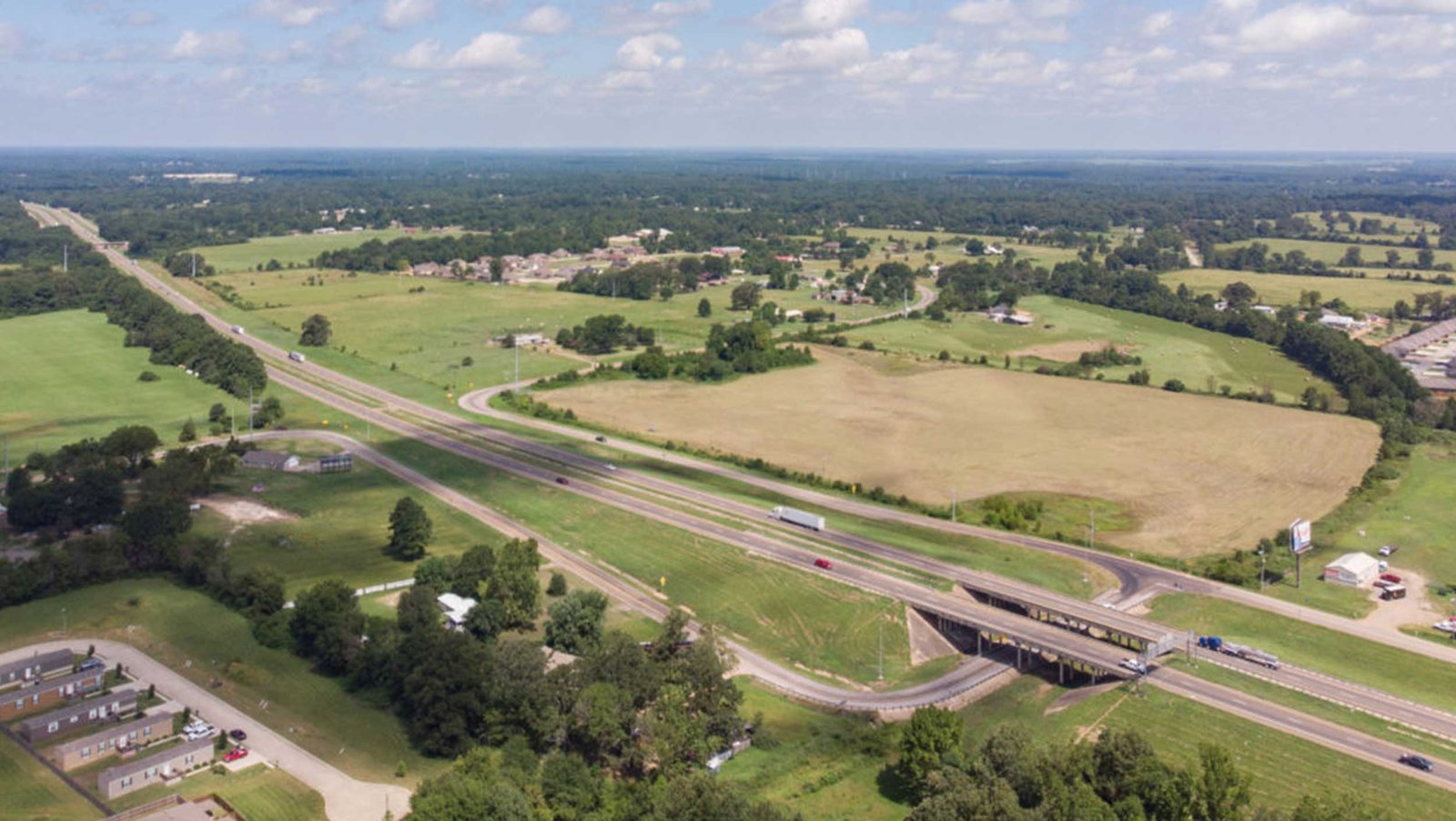
Downtown Texarkana jobs are small in footprint and large in consequence. A pour behind a storefront has one alley for the truck, one neighbor who opens at eight, and an old utility line nobody has a drawing for. That is the work we plan around in the core of Texarkana, Texas: infill footings, slabs on grade, sidewalks, curb returns, dock and equipment pads, and the tie-ins where new concrete meets an old building.
The city sits where U.S. Highways 59, 67, 71 and 82 meet, with Interstate 30 along the north side and Loop 151 on the west, according to a general geography reference. For a concrete contractor that matters in a plain way: ready-mix trucks and pump rigs can reach most downtown blocks from several directions, so we can pick the approach that keeps a lane open instead of the one that closes a street. Downtown is also where institutional work shows up. A state licensing record lists a Phase 1 audio and visual modernization of a 29,700 square foot theater at 221 Main Street, estimated at $2,500,000 and scheduled to run from July 1 to November 3, 2026. That is a record of the scale of work happening in a historic district, not a claim about who is doing it, but it tells you what a downtown owner is dealing with: interior floors, stage and lobby penetrations, accessible routes, and a building that cannot go dark for long.
Before a single form goes up we confirm which codes govern the job. The city Inspections office at 220 Texas Blvd, Municipal Building, Room 301, lists the International Building Code and the National Electrical Code as presently in use, with plans also required to meet the Texas Accessibility Standards. The edition in force should be confirmed with the City.
Infill concrete the way a tight block demands it
Most core projects start with a footing or a slab inside a footprint that already has neighbors on three sides. We hand-dig or pothole first, because the first foot of soil downtown is where abandoned lines and old foundations hide. Then we form and place sidewalks and flatwork to the grades the survey calls for, with joints laid out before the pour so saw cuts land where the finish crew can reach them, not where the truck left a rut.
The city's downtown revitalization page describes a strategy built on existing assets, the Arts and Historic District, the Farmers' Market, the Perot Theatre and the Scott Joplin Mural, and an arts-focused pedestrian promenade supported by a $100,000 National Endowment for the Arts Our Town grant. Concrete that people walk on every day lives or dies on accessible route details: slopes, landings, detectable warnings and the transitions where a new walk meets an old threshold. We build those to the plan set and check them with a level before the concrete sets, not after the inspector arrives.
Permit counter, floodplain review and accessibility
Texarkana's Hazard Mitigation Plan notes that portions of the city, mostly following waterways, lie in the 100-year floodplain, and it names Swampoodle Creek just east of downtown among impaired streams. The city participates in the National Flood Insurance Program and requires a floodplain permit reviewed by the City Engineer as floodplain administrator. If your parcel is near that creek, we ask for the floodplain determination before pricing, because finished floor elevation, fill placement and drainage all change when a site is mapped inside the line.
Accessibility review is the other gate. Plans must satisfy the Texas Accessibility Standards and Texas Department of Licensing and Regulation requirements, so ramps, curb cuts and restroom slabs get drawn and built to those dimensions. We keep a pour log and a copy of the approved plans on the site, so when an inspector asks about a landing slope or a rebar spacing, the answer is a page in a binder, not a phone call.
Red clay, sandy loam and 42 to 58 inches of rain
The hazard plan places Texarkana in the rolling Tertiary Uplands, where soils are mostly well-drained with sandy and loamy surfaces, and in the East Texas Timberlands, where upland soils are acid sands and loams over loamy and clayey subsoils, with red clays in areas of redlands. That is why a downtown slab can sit on friendly sand at one corner and a stiff clay subgrade at the next. We proof roll, probe and sometimes over-excavate and recompact before we trust a subgrade with a slab.
Rain is the schedule risk. The same plan reports average annual rainfall of 42 to 58 inches in the Piney Woods area and notes the area is prone to tornadoes and hailstorms, with seven tornadoes and two funnel clouds in city records and $5.3 million in damage. Plastic-sheeted subgrade, a standing plan for covering fresh concrete and a forecast check the afternoon before every pour day are habits here, not extras. Wider regional conditions are covered on our page for Bowie and Cass county site conditions.
Crews that form, place and cut their own work
Because the core is infill, we coordinate the pieces that otherwise pass between trades: forming, rebar and chair placement, pump and chute placement, finishing, curing and saw cutting. Hand-held and small-rig equipment fits where full-size machines do not, and one crew boss owns the pour from the first stake to the last curing blanket. That keeps the sequence honest when a pour has to be done and swept before a downtown business opens.
Renovations bring the opposite task. Concrete demolition and removal comes first, sawn in sections so we do not crack the slab we are keeping, then dowels are drilled and epoxied where new work ties to old. We sort the haul-off, keep the street swept, and photograph exposed conditions for the engineer when we find something the drawings missed.
Rail town logistics and pour windows
The Handbook of Texas describes Texarkana as a major railroad center by 1948, the junction of four railroad systems with eight outlets, laid out on the Texas side by the Texas and Pacific Railway. The street grid still bears that mark, and freight rail still runs through the same corridors, so crossings and trains are real constraints for trucks. We plan around the Union Pacific and KCS rail lines by routing mixer trucks away from known blocked crossings and having a backup entry for every pour day.
For work off the main interchange, the I-30 corridor gives the batch plants a fast route in. We schedule early starts for downtown flatwork, order in smaller loads when access is constrained, and hold a rain plan for each placement. If a storm moves the pour, we tell you the morning before, not at the curb.
Owners who build in the core
Our downtown clients tend to be commercial developers filling a pad or renovating a street-front building, and municipal and public works offices fixing walks, curbs and drainage. Developers ask us about schedule and finish quality. City staff ask about specifications, testing and warranty. We answer both with the same documents: mix tickets, slump and temperature at the truck, and cylinder breaks reported against the specified strength.
Walk the block with us
Send us the address and the plans, even if they are only a sketch. We will visit the site, check access, floodplain status and soils, and return a written scope with pricing and a pour schedule that fits your building's hours.
Common Questions
Which building code edition applies to a downtown Texarkana, Texas project?
The City Inspections page lists the International Building Code and National Electrical Code as presently in use. We confirm the edition with the Inspections Department at the start of each job, and we design slab thickness, reinforcing and accessibility details to whatever edition your permit cites.
Do I need a floodplain permit for a lot near the creeks east of downtown?
If any part of the parcel falls in the mapped 100-year floodplain, the city requires a floodplain permit reviewed by the City Engineer. Swampoodle Creek runs just east of downtown, and the hazard plan notes that floodplain mostly follows waterways. We ask for the determination early, since it can raise the floor elevation or change drainage and fill requirements.
How do you handle pours when trucks cannot park in front of the building?
We pull a site plan before pricing and look at alley widths, overhead lines and the nearest crossing. Often we use a pump from the side street, order smaller loads at tighter intervals, or place by hand-pushed buggies. The goal is one continuous placement with no cold joint, even if the truck cannot get closer than the curb.
What does rain do to downtown schedules?
Texarkana sees roughly 42 to 58 inches a year, so rain delays are normal. We keep poly and curing blankets on the site, close the subgrade before storms, and refuse to place on standing water. A pour that moves a day costs less than a slab with a weak surface, and we say so in the bid.