
Storm Drain Installation in Texarkana, Texas
Storm drain pipe, inlets, junctions and outfalls for commercial and industrial sites in Texarkana, built for heavy rain, clay soil and floodplain review.
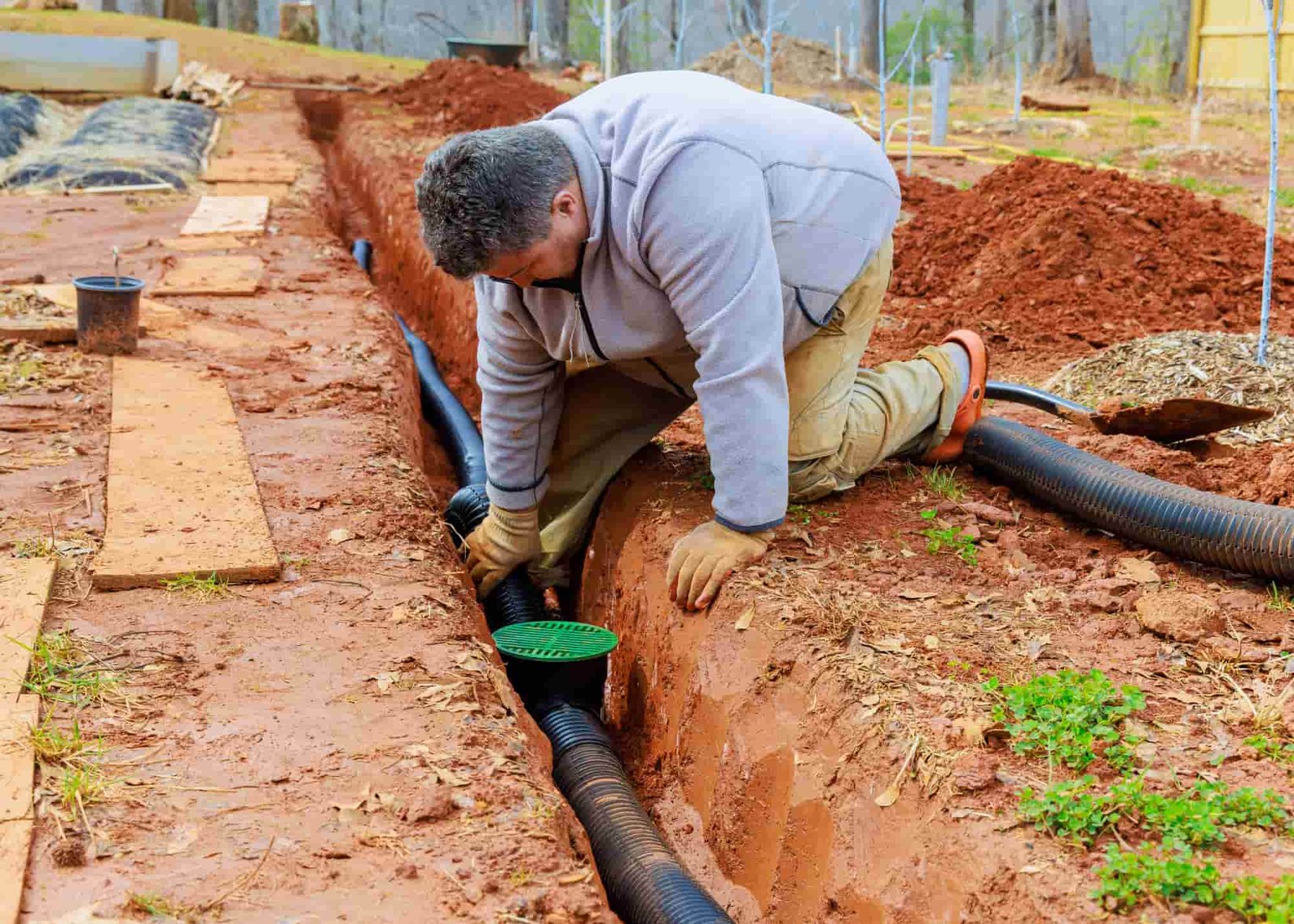
Rainfall of 42 to 58 inches a year does not fall politely. In Texarkana it arrives in bursts, on top of clay that cannot absorb it, and the storm system under a parking lot has to carry that water out before it reaches a loading dock door. Storm drain installation is the work that turns an engineer's drainage map into pipe, inlets, junctions and outfalls in the ground, and it is where a mistake on elevation tends to flood somebody.
We build storm systems for retail centers, distribution buildings, schools, industrial yards and municipal projects. The work includes curb and grate inlets, area drains, reinforced concrete pipe and high-density polyethylene pipe, junction boxes, manholes, headwalls, outfall protection and the connection to a city system or a detention basin. Because we coordinate the concrete as well, the inlets and boxes are scheduled with the rest of the work rather than waiting on a separate subcontractor.
The rest of this page describes how we plan the system, the ground we work in, the standards behind it and what a fair bid should cover.
Highway projects that set the standard
TxDOT's project page for US 82 from just west of US 259 to south of I-30 lists a new storm drain system with inlets, reconstruction of ramps on both sides of US 259, and relocation of an existing trail about 25 feet south. That is a public example of what a modern storm system looks like in this area: inlets at every low point, pipe sized for the design storm, and care for the trail and ramps that sit above it.
Private owners benefit from the same discipline. A town like DeKalb sees a new storm drain system with inlets added in part of the widening project, along with sidewalks inside city limits. When public work upgrades a street, adjacent owners often need to connect to it, and the grade of their private drain has to meet the new public one. We check this early.
Inlets, pipe and structures
We start with the structures because they control the pipe. Inlet tops are set to finished pavement grade, boxes are placed to the plan's inverts, and pipe is laid between them with a laser. Reinforced concrete pipe is common on larger runs and under heavy traffic; polyethylene is used for lighter duty and longer lengths where the engineer allows. The joint type, gasket and bedding follow the manufacturer's rules.
Where the plan includes curb inlets, they must sit exactly where the curb and gutter crew will finish the line, and the throat opening must match the curb height. Where it includes a trench drain across a dock apron, we coordinate with our trench drains and concrete drainage work so the trench drain and the main line share the same invert.
Streams, floodplain and downstream limits
The 2024 Hazard Mitigation Plan lists Cowhorn Creek, between Summerhill Road and Robinson Road, among the impaired streams in the city, and says the 100-year floodplain mostly follows waterways. A storm system that ends at such a creek needs more than a pipe: it needs an outfall that does not erode the bank, a sediment plan during construction and a design that does not worsen the flood condition downstream.
That means detention on many commercial sites, and a storm drain plan is only as good as the pond it feeds. We sequence the pond excavation first when possible, so the construction runoff goes to a controlled basin. The flat ground and clay near the creek corridors also means shallow slopes, and shallow slopes mean pipe laid with very little room for error.
Elevation first, then everything else
The highest-risk number on a storm job is the outfall invert. If it is wrong, every pipe above it is wrong. We confirm it with survey before we open any trench, then work from the outfall upstream so the pipe always has a verified low point. Every inlet and junction invert is checked against the plan the day it is set.
Backfill around storm pipe matters more than people think. Concrete pipe has a design strength that assumes a certain bedding, and poor backfill takes that margin away. We place and compact in lifts, keep equipment off the pipe until the cover is sufficient and test density where the specification calls for it. When a run crosses a gas, water or fiber line, we hand-dig the crossing, support the existing utility and record the clearance, because a storm line that is a few inches too close to a gas main will be cut out and redone at our expense.
Permits and erosion control
The City of Texarkana, Texas requires a floodplain permit reviewed by the City Engineer where work touches a mapped floodplain, and storm drainage plans for commercial sites generally go through plan review before construction. Inspections is at 220 Texas Blvd, Municipal Building, Room 301. Large disturbed areas also bring the state's construction stormwater requirements into play, which we discuss in our erosion control and SWPPP work.
We install inlet protection the day an inlet is set, because a storm system that works perfectly in a year can fill with silt during the month it is built. A cleaning allowance before final acceptance is usually part of the contract. Where a site drains toward a county or state road, expect another reviewer in the loop, and expect that reviewer to want the same inlet and outfall details shown on the plan set before the first permit is issued.
Related drainage structures
Storm systems rarely end at the last inlet. They run to detention and retention ponds, under roads through culverts and headwalls, and into manholes and vaults built by our trade partners. A coordinated design avoids the situation where the pond is sized for flow the pipe cannot deliver.
For retail and commercial clients, a storm plan under a retail shopping center is also a customer-experience plan: parking lots that pond after a storm lose business. For public owners, municipal and public works agencies want clear as-builts so the city can maintain the inlets and pipe afterward, and we provide them.
Have your drainage plan priced
Send the civil plan with the drainage sheets. We will price the pipe, structures, outfall and erosion protection as separate items you can compare.
Common Questions
What size storm drain pipe do I need?
The engineer sizes it from the drainage area, the design storm, the slope and the allowable headwater. Pipe sizes on commercial lots commonly start at 18 inches and grow with the drainage area. We build to the plan, but we review pipe sizes and inverts for conflicts with other utilities before construction starts.
Why do inlets settle or crack?
Usually from poor backfill around the structure, traffic over uncompacted ground, or an undersized foundation under a precast box. Clay soils move, so the base under an inlet needs compacted stone or a poured base. We set structures on prepared beds and compact around them in lifts.
Do I need detention if I connect to a city storm system?
Often yes. Cities limit the peak flow leaving a site to its pre-development rate, and detention on site handles the difference. Ask the City Engineer early, because the answer affects land use as well as cost.
What does it cost to repair a storm drain after paving?
Considerably more than doing it right the first time. A failed pipe under new pavement means saw-cutting, excavating, replacing, compacting and repaving. We recommend a video inspection before paving on larger systems to find defects while the surface is still open.
How is stormwater handled during construction?
Inlet protection, silt fence, stabilized entrances and a sequence that builds the outfall and basin before the rest of the site. A storm drain should not become a conveyor for sediment. We install and maintain controls through the work.