
Concrete Paving in Texarkana and Northeast Texas
Concrete paving for Northeast Texas roads, truck routes and industrial yards: subgrade treatment, reinforced slabs, joint layout and curing for heavy loads.
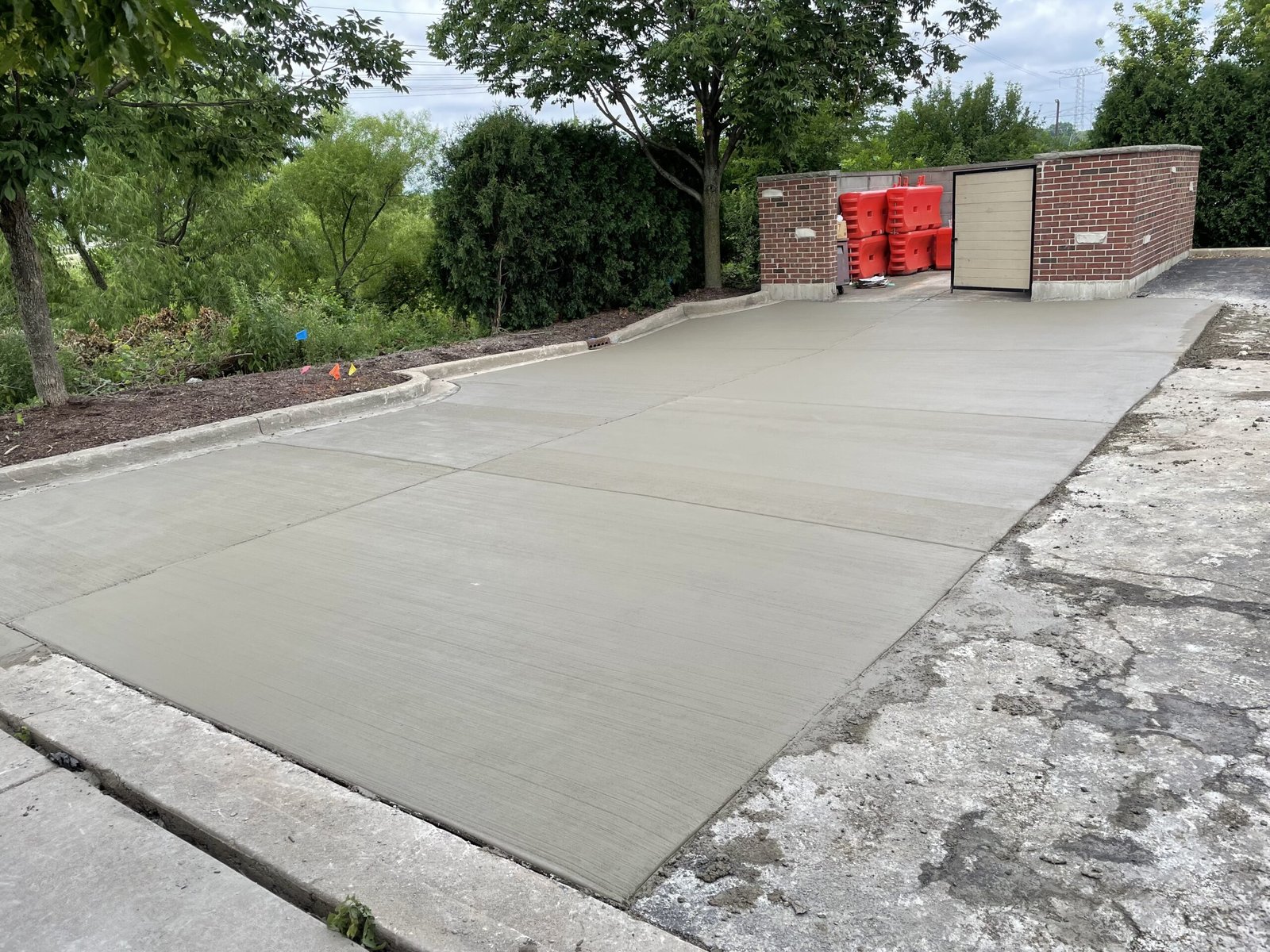
Continuously reinforced concrete pavement is replacing asphalt on part of I-30 in Bowie County. TxDOT's widening project covers 6.8 miles from just west of FM 989 to the state line, with three 12-foot lanes each way, 10-foot shoulders and a continuous concrete median barrier. When the state chooses concrete for the busiest road in the county, it says something about how it expects pavement to perform under trucks. The I-30 corridor is one of the main routes freight takes through our market, and every private yard that connects to it feels the same loads.
Concrete paving is a thick, reinforced slab placed on a prepared base and designed to carry heavy axle loads for a long time. Compared with asphalt, it costs more at the start and typically needs less maintenance, which is why public agencies and large logistics owners look at it. A pavement that carries tens of thousands of truck passes does not forgive shortcuts in the base. It rewards good subgrade work and punishes bad drainage, which is why the preparation consumes so much of our attention. A pavement slab that pumps fines out of its joints in year three was almost always built on a base that never drained.
We pave private and public sites: truck routes, yards, industrial roads, entrance drives and the heavy-duty pavement at warehouses and plants. We do not claim the state highway work. We describe it because it sets expectations for what concrete pavement means in this market.
Why concrete pavement is getting attention here
The freight picture explains it. TxDOT says the US 82 corridor in Bowie County is part of the Texas Trunk System, the National Highway System and the Texas Freight Corridor, and the Atlanta District is preparing to widen it from two lanes to four. A 3.5 mile segment of US 59 from I-30 to Loop 151 was designated I-369, and a route study looked at extending interstate standards south toward Queen City in Cass County.
More trucks and more freight mean more owners asking for pavements that do not rut or pothole. Industrial parks, distribution buildings and transfer yards want slabs that last through heavy wheel loads and sit on clay that moves with the seasons. That is the demand we aim at, and it shows up on the US 82 corridor as much as on the interstate. Owners with truck-heavy yards, including truck terminals and cross-docks, are the clearest example.
Pavement we build
Typical scope includes fine grading and stabilization of the subgrade, base stone or cement-treated base, reinforcing steel or mesh, dowelled joints, placement, texturing, curing and joint sealing. We pave in lanes or panels with forms or a slip form paver, depending on the size of the job.
Heavy-duty areas, such as truck courts and dock aprons, get thicker sections and dowelled transverse joints. Light-duty areas, such as parking lot concrete for cars, can be thinner, with a different joint plan.
What our trade partners do
Subgrade work is not left to someone else. We coordinate stripping, cut and fill, proof rolling and finishing the base, because the paving tolerance depends on it. If the soil needs lime or cement treatment to stiffen, we plan for it as part of the paving scope, and our road subgrade preparation work follows the same proof-roll discipline we use under buildings.
Forming, reinforcing, placing, finishing, curing and sawing are done by us as well. That keeps responsibility in one place, so a joint cut a day late is not someone else's problem. See our lime and cement soil treatment work for the base side of the story.
Design, standards and testing
Concrete pavement design is done by an engineer who sets the thickness, reinforcing and joint pattern. For highway-adjacent work, TxDOT standards apply. For private sites, the owner's engineer typically follows the geotechnical report and expected traffic. Texarkana, Texas plans also need to pass the city drainage and accessibility reviews.
We test slump, air and strength as the specification requires. Surface tolerance is checked with a straightedge or profiler, and joint layout is marked before sawing starts. Saw cuts are timed to the strength of the slab, usually within hours of placement in warm weather, since waiting too long invites random cracks. Curing records and weather notes are kept for the file.
Weather windows and traffic
Paving runs best in dry weather, on a base that has had time to drain. Rain, extreme heat and strong wind can all upset a paving day. We plan the work in long stretches when the forecast supports it and give ourselves a reserve of days for weather.
When paving an existing road or yard, we phase the work so traffic can pass. Detours, lane closures and temporary access are planned with the owner. Full-depth patches and transitions to existing pavement are built before the larger placements. Joint sealant goes in after the slab has cured and dried, because sealing too early traps moisture and fails in the first year.
Working around trucks and traffic
Paving crews work next to moving equipment, and often next to public traffic. We set up barricades, signs and flaggers, keep walking paths away from trucks, and brief the crew each morning on the day's hazards.
Our site plans include haul routes, staging areas and wash-out locations, so the concrete trucks do not tear up the base we just graded. Utility locates and potholing come before any excavation. Oil and gas operators and other yard owners, such as those described under oil, gas and midstream, often need the pavement poured around live pipe and wellhead equipment, which makes a crew briefing before the first cut mandatory.
Send the pavement section
Send the pavement design, the geotechnical report and the area. We will price the base, the slab and the joints, and tell you which weather window we would choose.
Common Questions
Is concrete pavement better than asphalt for heavy trucks?
Concrete usually carries heavy wheel loads with less rutting and a longer life, at a higher first cost. Asphalt costs less up front and is easier to patch. The best answer depends on traffic, soil and how the owner counts life-cycle cost.
How thick does a truck pavement need to be?
The engineer sets the thickness from loads and soil. Truck areas are thicker than parking for cars, and they use dowelled joints. We build the section on the drawings, and we ask questions when it does not match the traffic described.
How long before trucks can use new concrete pavement?
It usually takes days for light traffic and longer for heavy trucks, depending on strength tests and weather. We confirm strength by cylinder breaks and tell the owner the earliest safe date.
Do you build over soft clay?
Yes, with preparation. We proof roll, remove soft areas, add stabilization or stone as the report requires, and drain the base. Paving soft clay without that work leads to pumping and cracking.