Commercial Concrete Contractor in Texarkana, Texas
Commercial concrete for Texarkana and Northeast Texas: foundations, slabs, flatwork and structural pours built to the subgrade, the permit and the schedule.
A commercial pour in Texarkana, Texas really begins in Room 301 of the Municipal Building at 220 Texas Blvd, where the Inspections office takes plans and answers the questions that decide whether a slab gets placed on schedule. We work with that office, and with the owner, the architect and the general contractor, so that what is drawn can be built on the ground the project actually sits on.
Commercial concrete here means more than a floor. It is the footing that has to bear on stiff clay, the slab that has to survive forklifts, the apron that has to take a loaded tractor-trailer turning on it, and the sidewalk that has to meet accessibility rules at the door. We build each of those with the same priorities. Subgrade first, then reinforcing and joint layout, then placement and curing. The finish is the last thing we talk about, and it is the least likely to cause a call-back.
Most of our commercial work comes through general contractors and developers who need a concrete scope they can schedule around and not worry about. We bid from complete drawings, flag what is missing before we price it, and tell you plainly when a detail will not work in Bowie or Cass County dirt.
Permits, plan review and the code question
The City of Texarkana, Texas Inspections page says the city presently operates under the International Building Code with the National Electrical Code, and that plans must also comply with the Texas Accessibility Standards. The edition in force should be confirmed with the City. Before we release a mix design or a rebar order, we ask the Inspections Department, in writing, which edition governs the job.
Permits come from the city where the site sits. A third-party permit guide reports no general county building permit in Bowie County, so work inside Texarkana, Nash or Wake Village goes through that town, and unincorporated sites need a call to the Commissioners Court. Accessibility review runs through the state under the Texas Accessibility Standards, which matters for every ramp, curb cut and entry slab we pour.
What we place on commercial sites
The core of the scope is structural and slab work: concrete foundations, slab-on-grade floors, and cast-in-place structural concrete for walls, columns and framed elements. Around the building we pour the sidewalks, curbs, dumpster pads and truck areas that tie the site together.
We also handle the site work that sets up the concrete, which is where a lot of commercial jobs are won or lost. Building pad preparation, over-excavation of soft pockets and proof rolling of the subgrade are part of how we price and schedule, not a separate afterthought handed to someone else.
How a commercial pour day is run
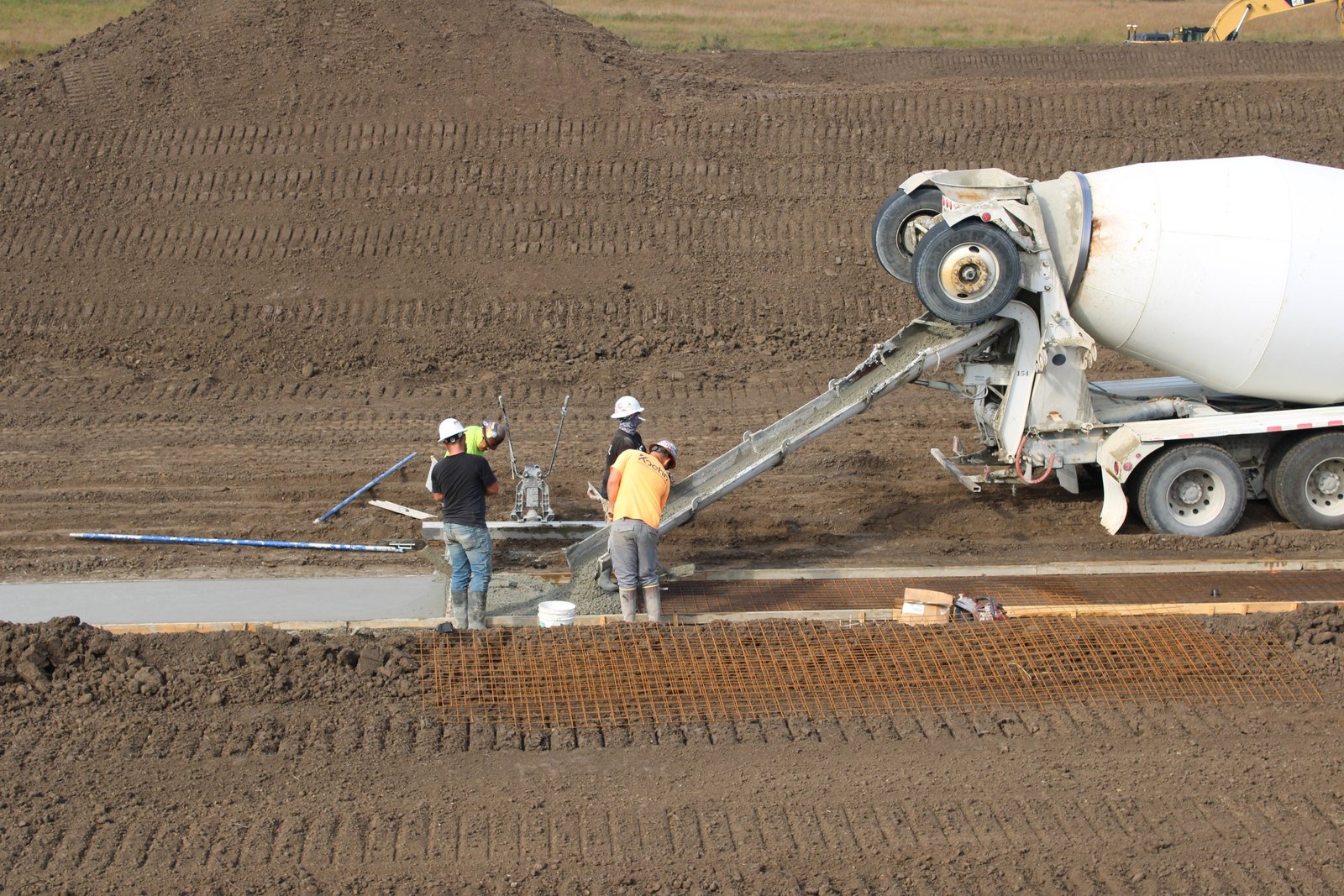
Pour day is planned backward from the cure. We confirm the subgrade has passed a proof roll, check rebar chairs and cover, set the pump or chute access, and agree on joint locations before the first truck is released. We keep slump to the mix design and do not let anyone add water at the chute to make a finish easier.
Curing blankets and membrane cure go down right behind the finishers, because the first day decides how a slab behaves for years. Test cylinders are cast and handled as the spec requires, and the concrete testing and quality control results go to the general contractor as they come back, not at closeout.
Buildings we pour for in this market
Texarkana's economy leans on distribution, healthcare, education and manufacturing, and the concrete follows. We pour for medical office buildings, retail centers along the arterials, warehouses and light industrial shells, and public buildings.
Each type asks something different of the slab. A clinic needs flat, dry floors for flooring adhesives. A warehouse needs joint layout built around racking and traffic. A retail pad needs its drainage correct before the owner ever sees the finish. We read the drawings for what the owner will do with the floor, not just what the structural sheet says.
What to settle before we price
Three questions shape a commercial bid in Northeast Texas: what the geotechnical report says about the clay, who owns the weather risk, and how the pour sequence ties to the framing or the roof. We would rather answer those in the preconstruction meeting than argue about them after a rain delay.
Developers can start with our work for commercial developers, and builders running multiple trades can see how we coordinate on general contractor and construction manager projects. For site-specific conditions, the Texarkana core and downtown page covers what we plan for inside the city.
Send us the plans
Send the drawings and the geotechnical report if you have it. We will review the concrete scope, flag the open items and give you a number you can build a schedule around.
Common Questions
Do you need a permit from the city for a commercial slab in Texarkana?
Inside city limits, plans go to the Inspections Department at the Municipal Building, and the permit is normally pulled by the general contractor or owner. The City also requires accessibility compliance under the Texas Accessibility Standards. Outside city limits, a third-party guide reports Bowie County does not issue a general building permit, so we confirm with the county before we assume anything. We help assemble the concrete information the plan reviewer asks for.
Which building code edition applies to my project?
It depends on the jurisdiction and the date of the application. The City page lists the International Building Code. We ask the Inspections Department which edition applies before we finalize reinforcing and joint details, and we put the answer in writing for the general contractor.
How does heavy clay affect a commercial concrete bid?
Heavy clay swells when it is wet and shrinks when it dries, so the subgrade has to be prepared and protected, not just graded. We price proof rolling, moisture conditioning and sometimes over-excavation and engineered fill when the geotechnical report calls for them. Skipping that work looks cheaper at bid time and costs more when a slab moves.
How do rain delays get handled?
Northeast Texas gets a lot of rain, and a wet subgrade stops a pour for good reason. We put weather language in the schedule early and watch the forecast through the week before a pour. If the forms and rebar are in place and the weather turns, we have covers and a plan to protect them, but we will not place concrete on a saturated base to hold a date.
Can you work as a subcontractor under our general contractor?
Yes. Most of our commercial work is as the concrete subcontractor under a general contractor or construction manager. We bid from the drawings, coordinate pour dates with the other trades and report test results as they arrive.