
Post-Tensioned Slabs in Texarkana, Texas
Post-tensioned slabs for Bowie and Cass County clay: tendon layout, stressing, safe cutting rules and the subgrade and drainage work that goes with them.
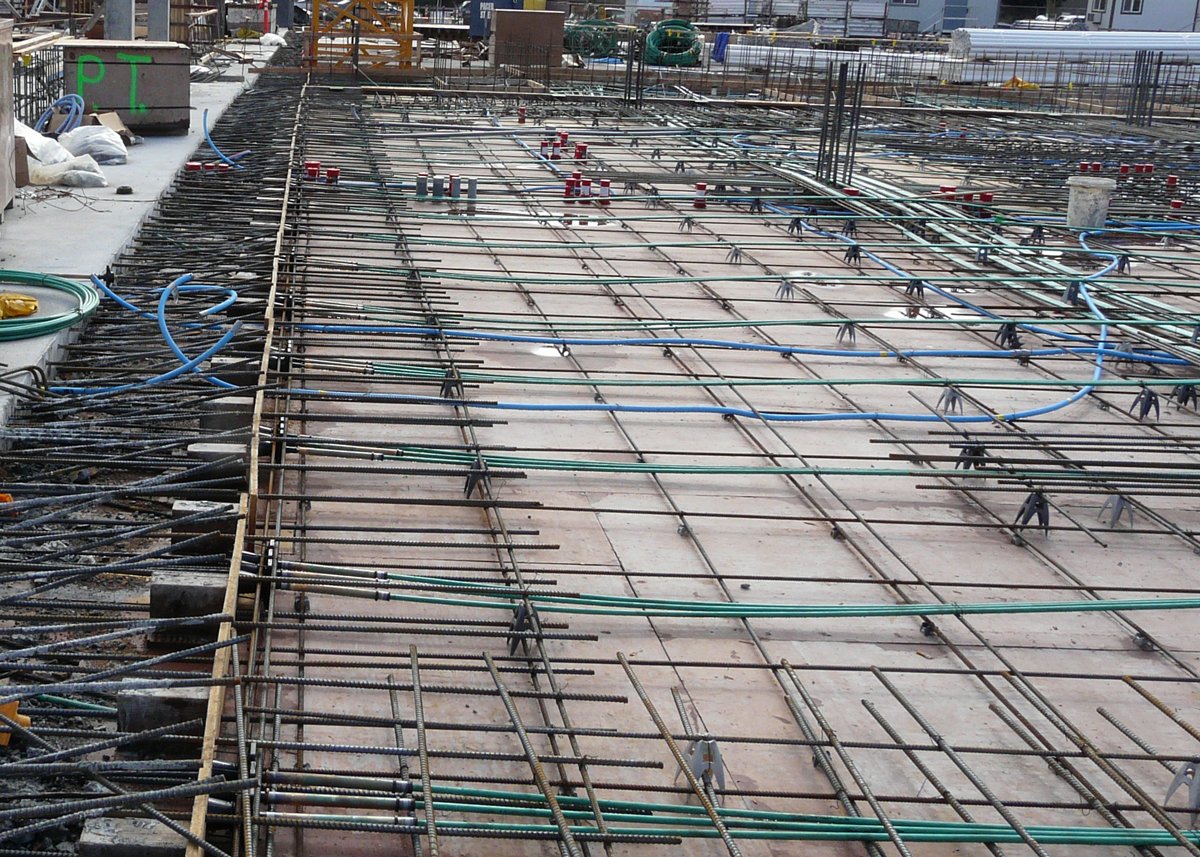
Heavy clay moves, and a post-tensioned slab is one way to build a floor that moves with it instead of breaking up. Steel tendons are laid in a plan the engineer designs, then stressed after the concrete gains strength, which squeezes the slab into compression and ties it into a stiff plate. On the shrink-swell soils that run across Bowie and Cass counties, that stiffness is the point.
We place and coordinate post-tensioned slabs for commercial buildings, light industrial shells and large floors where the engineer wants to cut down on joints or control cracking over weaker ground. The tendons themselves usually come from a specialty supplier and are stressed by a certified crew. Our work is the base, the forming, the placement, the finishing and the schedule that all those pieces depend on. When any one of those slips, the tendon crew waits, and waiting on a slab on clay in a wet month is how a clean schedule turns into a muddy one.
This is not a product we push. In many buildings a conventional reinforced slab does the job at lower cost. When a geotechnical report and a structural engineer call for post-tensioning, we make sure it goes in correctly.
Why the ground here makes people ask about it
The USDA description of the Texark soil, whose type location is in Bowie County, gives an apparent water table at 2 to 3.5 feet and very slow permeability, on flood plains. Water arrives easily and leaves slowly. A slab sitting on that kind of soil sees wet-dry swings that a stiffened floor can ride out better than a thin, jointed one. It also means the base must drain, so we look at how water leaves the pad before we think about how the slab is reinforced.
Weather is part of the story too. Bowie County issued a disaster declaration effective April 7, 2025 after heavy rain and flooding over a single weekend. A pour schedule in this market has to plan for rain that can arrive suddenly and soak the base. The same Hazard Mitigation Plan that covers Texarkana lists 10 repetitive loss structures with 66 total losses in the city's flood insurance records, a reminder that drainage and elevation matter as much as the slab itself.
How a post-tensioned pour is staged
The sequence is tight. We finish the subgrade and the vapor barrier, set edge forms and any beams, and then the tendon crew lays out the cables to the shop drawings, with chairs holding them at the right profile. We check tendon heights, end fittings and bundles against the drawings before anyone calls for concrete. Any tendon that is kinked, sagged or pinned to the base by a careless boot is a problem we can fix in five minutes before the pour and not after it.
Placement follows with a mix that is designed to reach the stressing strength on schedule. Curing is immediate. Once the concrete tests at the required strength, the stressing crew jacks each tendon to its design force while we keep the area clear and record the elongations. After stressing, the pockets are patched and the slab is released for the next trade.
Why cutting and coring need a plan
A stressed tendon is under heavy tension. Cutting or coring into one without a plan can be dangerous and expensive. We mark tendon locations on the slab after stressing and require a scan before any sawing, drilling or coring, including work we coordinate and that of the plumbers and electricians.
This matters for later renovation too. Owners should keep the tendon layout drawings in the building file, and anyone considering a penetration should talk to the engineer first. A drain line or conduit that seems minor to a tenant can be a serious matter in a stressed slab. The concrete sawing, cutting and coring trade crews follow that rule on every post-tensioned floor.
Engineering, submittals and inspection
Post-tensioned slabs are engineered elements, and the structural drawings and tendon shop drawings are submitted and approved before work starts. Inspection typically includes tendon placement, end fitting details, stressing records and cover. The City of Texarkana applies its adopted building code and the Texas Accessibility Standards to plans, and the edition in force should be confirmed with the Inspections Department.
We keep a log of tendon elongations and stressing dates, and we assemble the records that the engineer needs to accept the slab. Reinforcing in beams and at slab edges still matters, so the rebar placement trade crews coordinate with the tendon installer on congested areas.
What changes the price
Post-tensioning trades fewer joints and sometimes thinner slabs for the cost of tendons, end fittings, stressing and extra coordination. The net comparison with a conventional slab depends on the soil, the span and the size of the floor. On weak or expansive ground, soil improvement can cost less than a heavier slab, which is where lime and cement soil treatment may enter the discussion.
Schedule changes the price too. The slab cannot be stressed until it gains strength, and a cold or wet week can push that date. We ask owners to build that wait into the construction sequence, so the framers or steel erectors do not arrive before the slab is released. Where soil improvement is part of the plan, engineered fill and soil stabilization is priced alongside the floor so the owner sees the whole ground-up cost.
Where this fits with our other work
A post-tensioned floor is one answer to a foundation question, and the broader choices are covered under concrete foundations. Many owners compare it against a thick conventional slab and against a pier-supported floor before choosing.
It is common in self-storage facilities and in residential and mixed-use projects built by homebuilders and multifamily developers, where large footprints and soft ground meet a short schedule.
Compare the options with us
Send the geotechnical report and the structural concept. We will price a post-tensioned floor against a conventional slab and tell you what the soil is likely to need either way.
Common Questions
Is a post-tensioned slab better than a regular slab on clay?
It depends on the soil, the building and the budget. Post-tensioning stiffens the slab and can control cracking over movement-prone ground, but it adds cost and a need for specialty crews. The engineer decides after reading the geotechnical report, and we price the alternatives so the owner can see both.
How long until the tendons can be stressed?
Stressing happens once the concrete reaches the strength the engineer specifies, which is usually confirmed by cylinder breaks. In warm weather that can be a few days. In cool or wet weather it takes longer. We plan the sequence with that wait in mind.
Can I drill or cut a post-tensioned slab later?
Only after the tendons are located and the engineer approves. Scanning the slab is standard before any coring or sawing. Keep the as-built tendon drawings with the building records and call the engineer before you plan a penetration.
Does post-tensioning remove the need for joints?
It reduces them but does not remove all of them. Construction joints and slab edges still need to be planned, and the engineer shows where. Our joint layout follows those drawings.
Do you supply the tendons and the stressing crew?
The tendon system usually comes from a specialty supplier with its own certified installation and stressing crew. We coordinate the base, forms, placement and finishing around them and keep the schedule and records in one place.