
Lime and Cement Soil Treatment in Texarkana
Lime and cement stabilization of red and blackland clays for pads, roads and parking in Bowie and Cass counties, with mix design, mellowing and density testing.
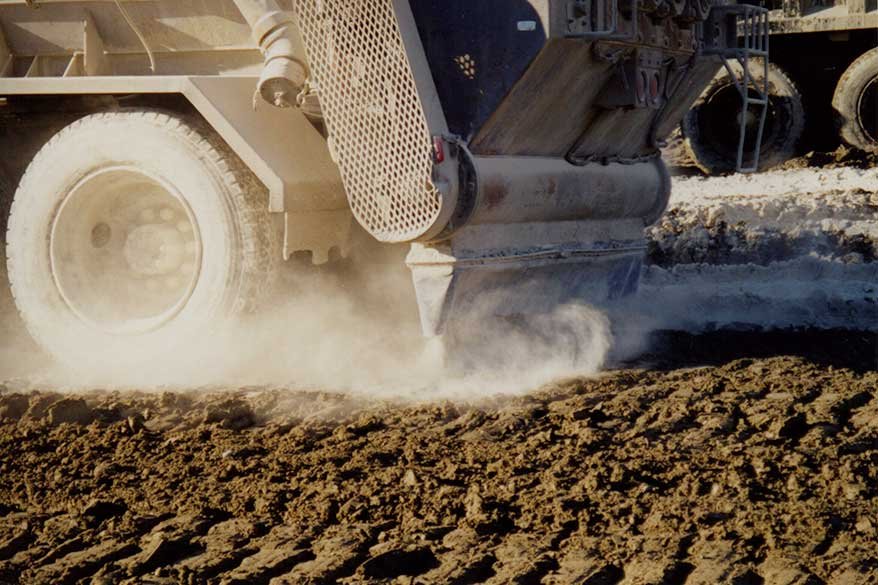
Lime does something to clay that no amount of rolling can. It changes the chemistry. Calcium from the lime exchanges with the sodium and other ions on the clay particles, the soil flocculates, plasticity drops and what was sticky, swelling material starts to behave like a granular soil. Add time and moisture and a slow cementing reaction follows, giving the treated layer real strength.
Cement works differently and suits different soils. It hydrates and bonds the particles directly, which is why it is favored for sandy and low-plasticity soils where lime has little to react with. Between the two, almost any subgrade in Northeast Texas can be turned from a liability into a working base.
We spread, mix, mellow, compact and cure treated layers for building pads, parking and drive lanes, haul roads and roadway subgrades, and we do it with attention to dust, wind and the neighbors.
The soils that call for treatment
The City of Texarkana hazard mitigation plan places the city in the East Texas Timberlands, where upland soils are acid sands and loams over loamy and clayey subsoils, with red clays in areas of redlands. Those clays are the usual candidates for lime. Acid soils and lime react well, and the improvement in workability after treatment is something a crew sees on the first day.
Highway work shows the scale of the need. TxDOT's I-30 widening in Bowie County replaces asphalt with continuously reinforced concrete pavement along 6.8 miles, and the planned I-369 extension study along US 59 covers about 16 miles in Bowie and Cass counties. Concrete pavements of that kind sit on stabilized subgrades, and the same practice carries to private industrial yards and truck courts.
The treatment sequence
The engineer sets the lime or cement percentage from lab tests on soil samples, often between four and eight percent by dry weight for lime in a high-plasticity clay. We confirm the application rate from the design, mark spreading lanes and calculate pounds per square yard for the lane width. Dry material is spread by a calibrated spreader truck, not by hand or by feel.
A reclaimer or stabilizer then mixes the binder to the specified depth. For lime, we usually add water, make a first pass, then leave the layer to mellow for twenty-four to forty-eight hours so the reaction can progress. After mellowing, we remix, bring the layer to moisture, compact and shape it. Cement skips the mellowing and goes straight to compaction, within the working time before the mix begins to set. Both are followed by moist curing or a light asphalt emulsion seal to keep the layer from drying out.
Getting a uniform mix
Uniformity decides whether the layer performs. Binder spread too thick in one lane and too thin in the next gives a treated layer with soft stripes. We check spread rate by laying pans or sheets of fabric on the ground and weighing what lands on them, and we adjust the spreader if needed. Depth is verified with a probe and a phenolphthalein spray, which shows pink where lime has reached.
Gradation of the mixed material is checked too. Clay clods larger than the spec allows need another pass. Compaction follows once the mix passes. A treated clay layer tends to be strong at the top and softer if the mix was shallow, so we mix a little deeper than the specified depth and trim after.
Dust, wind and the people next door
Lime is caustic. Quicklime in particular reacts violently with water and skin, so crews wear eye protection, gloves, long sleeves and dust masks and carry eyewash. We do not spread on windy days, and we keep the spreader boom low and use water to lay the dust. Neighbors, road users and vehicles are considered before application, not after the first complaint.
We also respect adjacent property. Sites close to occupied buildings, school campuses or public roads get a dust control plan, and spreading stops when the wind turns toward them. Cement dust is a silica hazard and is handled with the same care.
What treatment costs, and what it saves
The binder is a small part of the cost compared to the savings it creates. A layer of treated native clay replaces hauling out unsuitable soil and bringing in select fill, and it often shortens the schedule by weeks. The costs are binder, spreading, mixing, compaction, curing and testing. Wet ground that cannot be mixed without drying first adds days.
For comparison, see our over-excavation and recompaction and engineered fill pages. Many projects combine them: remove the worst, treat the middle and cap with stone. We price those combinations so the engineer can choose with the numbers in front of them.
Where treated subgrade shows up
Warehouse floors, truck terminal yards and concrete aprons depend on stable subgrades more than almost any other type of building, since a rutted truck court is an operating problem as well as a construction one. Our road subgrade preparation work uses the same methods. For developers working along the I-30 corridor, lime treatment is often the practical answer to clay that arrives wet from the cut.
Fitting treatment into a wet-weather calendar
Rainfall in the Piney Woods area runs 42 to 58 inches a year according to the city's hazard mitigation plan, so treatment crews plan around weather as a matter of routine. We watch the forecast three days out, start a lane only when we can finish mixing and compaction before the next front, and seal the surface at the end of each shift so a storm finds a tight layer instead of an open one.
The mellowing period needs to be in the schedule from the start. A pad that needs lime treatment, a day or two of mellowing, final compaction and a proof roll is not ready on the same afternoon the spreader arrives. Developers, commercial developers in particular, get the best results by sequencing treatment first on the critical path and letting utilities and footings follow, rather than treating soil in the middle of a congested site. We build a day-by-day sequence into the proposal so everyone knows when the surface will be ready.
Ask for a treatment comparison
Send us the soils report and the pad or pavement plan. We will price lime, cement and removal alternatives together so you can see what each option costs in dollars and days.
Common Questions
How long before we can build on lime-treated soil?
Pads can often be proof-rolled and built on within a few days of final compaction, provided the mellowing period is observed and the layer is cured. Strength keeps growing for weeks. The engineer sets the waiting period.
Will lime work on every soil?
No. High-plasticity clays react well. Sandy and low-plasticity soils usually need cement. Soils with high sulfate content can swell badly when limed, so the lab checks for sulfate before we spread.
Can you treat soil in wet weather?
Lime can sometimes dry a wet layer, which helps, but heavy rain stops the work. We do not spread binder in or just before rain, since it washes off and wastes material.
How deep does treatment go?
Typically six to twelve inches in one pass, and deeper in multiple lifts. Deep treatment of a whole pad is usually done lift by lift with the engineer's approval.
Is dust a concern near our occupied building?
It can be, so we plan for it. We spread only in suitable wind, keep the boom low, wet the surface and keep the area to a size we can mix and seal in a day. Tell us about neighbors and air intakes before we start.