
Culverts and Headwalls in Texarkana, Texas
Culvert installation and poured headwalls for private roads, truck entrances and public crossings in Bowie and Cass counties, sized for heavy rain.
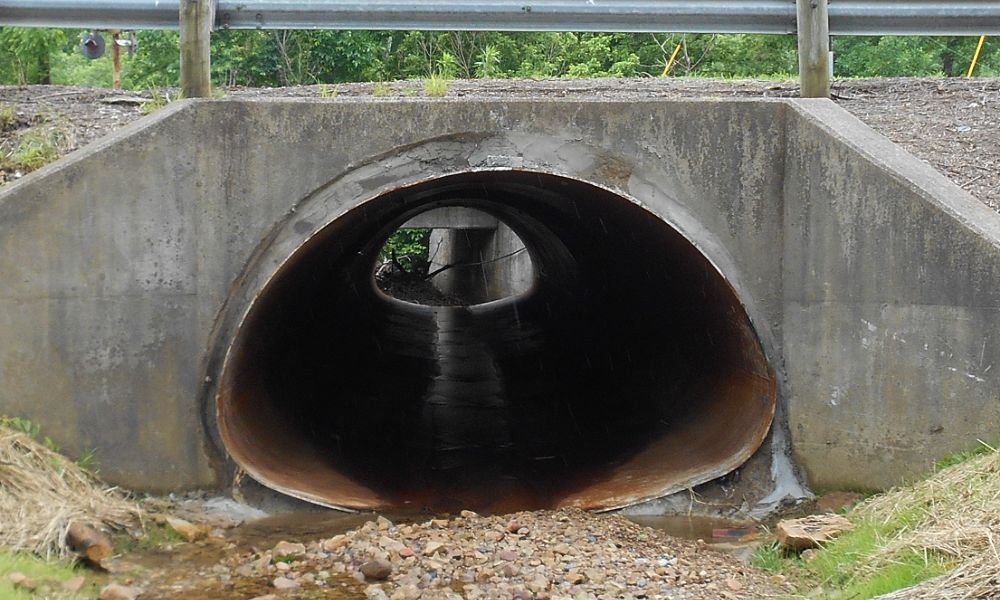
Cass County ranges from 167 to 627 feet in elevation, and that 460 feet of fall is what feeds the creeks, ditches and low crossings that every county road and driveway has to get across. A culvert is how a road crosses a ditch without damming it. It looks like a pipe under a driveway, and it is, until a 10-year storm tests whether the pipe is big enough, set low enough and protected well enough at its ends.
Culverts and headwalls are the small drainage structures that decide whether a road washes out. The culvert carries water under the road, the headwall holds the soil at each end and directs flow, and the apron, riprap or wingwalls keep the stream from undercutting the whole assembly. When one fails, the road goes with it, usually during a storm when nobody can repair it.
We install culverts and cast headwalls for private access roads, truck entrances, industrial yards, subdivisions and public road projects across Bowie and Cass counties. What follows covers how we size and set them, which materials we use and where jobs commonly go wrong.
Pipe, headwalls and aprons
A culvert crossing includes excavation, bedding, pipe, backfill, end treatment and often pavement or gravel on top. Pipe can be reinforced concrete, corrugated metal or plastic, and the choice depends on loads, flow, life expectancy and cost. Concrete pipe is the most common under heavy truck traffic. Box culverts, which are rectangular concrete sections, handle larger flows or shallow cover.
Headwalls and wingwalls are poured in place or set precast. They hold the pipe end against pulling out and protect the embankment from scour. Aprons of concrete or riprap spread the outflow so that it does not dig a hole at the exit. We coordinate forming and pouring these, with reinforcing, weep holes and drainage as the design requires.
Sizing, inverts and scour
A culvert that is one size too small acts as a dam in a flood. A culvert set too high leaves a pool behind it that never drains, and one set too low collects silt. The engineer calculates size and invert from the drainage area and the design storm, and our job is to build it to those numbers. We check upstream and downstream channel elevations before setting the pipe, because the drawing may not reflect a ditch that has silted or eroded.
Scour is the quiet failure. Water leaving a culvert has more speed than the channel can take, and it digs. We build aprons, energy dissipators and riprap as shown, and we keep the downstream channel stable. Annual precipitation of about 50 inches in Atlanta, in Cass County, tells you how often these structures work.
Roads that cross creek country
TxDOT's US 59 Texarkana to Queen City route study covered about 16 miles from SL 151 in Texarkana south to FM 2327 north of Queen City, in Cass County, for a route to be built to interstate standards as I-369. Any highway that long crosses many creeks and ditches, and each crossing needs a drainage structure. The same study says US 59 there does not currently meet interstate standards, which suggests a lot of drainage design when it gets built.
Private roads feed from those highways. A truck entrance to a distribution site or a farm road to a pasture needs a culvert that matches the road ditch, and the county or the state controls what can go in the ditch. We handle those permits and build to the standards of the entity that owns the road.
Installing a culvert that stays put
We excavate the crossing with a flat, firm bed, place bedding to the pipe manufacturer's standards, lay pipe from the downstream end and check line and grade. Backfill goes in layers along both sides, and nothing heavy crosses the pipe until cover is sufficient. A concrete pipe with a thin cover and a loaded truck above it is the cause of many early cracks.
Where the stream cannot be cut off, we divert flow with a pump or temporary pipe, build half the crossing at a time or schedule the work for dry weather. A culvert is one of the few jobs where we watch the forecast more closely than for a pour.
Who approves the crossing
The agency that owns the road or ditch approves the work: the state for state highways, the county for county roads, the city inside city limits. For work in a floodplain, the City of Texarkana, Texas requires a floodplain permit reviewed by the City Engineer. Larger drainage areas may involve federal permits for work in waters of the United States, which an environmental consultant can determine.
A third-party permit guide reports that Bowie County does not issue a general building permit, with septic the exception, so a private driveway crossing on a county road still goes through the Commissioners Court or the road department for the driveway approach. We confirm in advance, not after the pipe is in.
Cost and schedule factors
Pipe diameter, length and material set the base price. Depth of cover, headwall size, riprap quantity and traffic control follow. A culvert in a quiet farm road is a day or two of work; one on a busy county road with detours is a coordinated closure and costs accordingly.
Lead time is worth planning. Precast headwalls and large box sections may take weeks to arrive, and an inspector may need to witness the bedding. We order early and set the installation for the driest months, when the ditch is dry enough to work in.
Related drainage structures
Culverts typically feed from or into a detention or retention pond or join a storm drain system at a junction.
They are also part of rural road work, since a road subgrade that holds up depends on water getting out from under it, and in developed areas they sit beside curb and gutter.
For industrial and agricultural owners, agriculture and dairy operations often need crossings on private roads to reach pasture and barns, and we build them to the load of loaded feed and milk trucks. Our Queen City area coverage includes these rural crossings.
Have your crossing built right
Send the road plan and the drainage calculation, or tell us where the ditch is. We will propose a pipe, a headwall detail and a schedule that avoids wet weather.
Common Questions
How do I know what size culvert I need?
A drainage calculation determines it, based on the contributing area, rainfall intensity and allowable headwater. Rules of thumb are unreliable, and a size that fits one ditch can be far too small for another. If you have no engineer, we can recommend one for a short study.
Is concrete pipe better than corrugated metal or plastic?
Each has uses. Concrete is strong and long-lived under heavy loads. Corrugated metal is lighter and quick to install but can corrode. Plastic is easy to handle and resists corrosion but needs careful bedding. The right pipe depends on load, flow and the owner's standard.
What is a headwall for?
It holds the soil around the pipe end, prevents the pipe from separating or being undercut and guides water in and out. Without one, a pipe end in a ditch often fails after a few storms.
Can you replace a culvert without closing the road?
Sometimes, by building half the crossing at a time or by boring a new pipe. Many replacements need a full closure for a short time, and we plan detours and notices with the road owner.
Why does the water pond upstream after we install a culvert?
Usually the pipe is set too high, too small or partly blocked. We check inverts as we set the pipe and test flow after backfill. If ponding persists, we find out whether the issue is the culvert or the ditch.