
Curb and Gutter in Texarkana, Texas
Curb and gutter for Texarkana arterials, shopping center lots and subdivisions: machine-placed or hand-formed, graded for drainage and jointed to hold.
Five lanes with a center turn lane describes most of Richmond Road and Summerhill Road, the two arterials the City of Texarkana, Texas comprehensive plan treats as the major links between the newer parts of town north of I-30 and the center. Every one of those lanes ends at a curb, and the curb decides where the water goes.
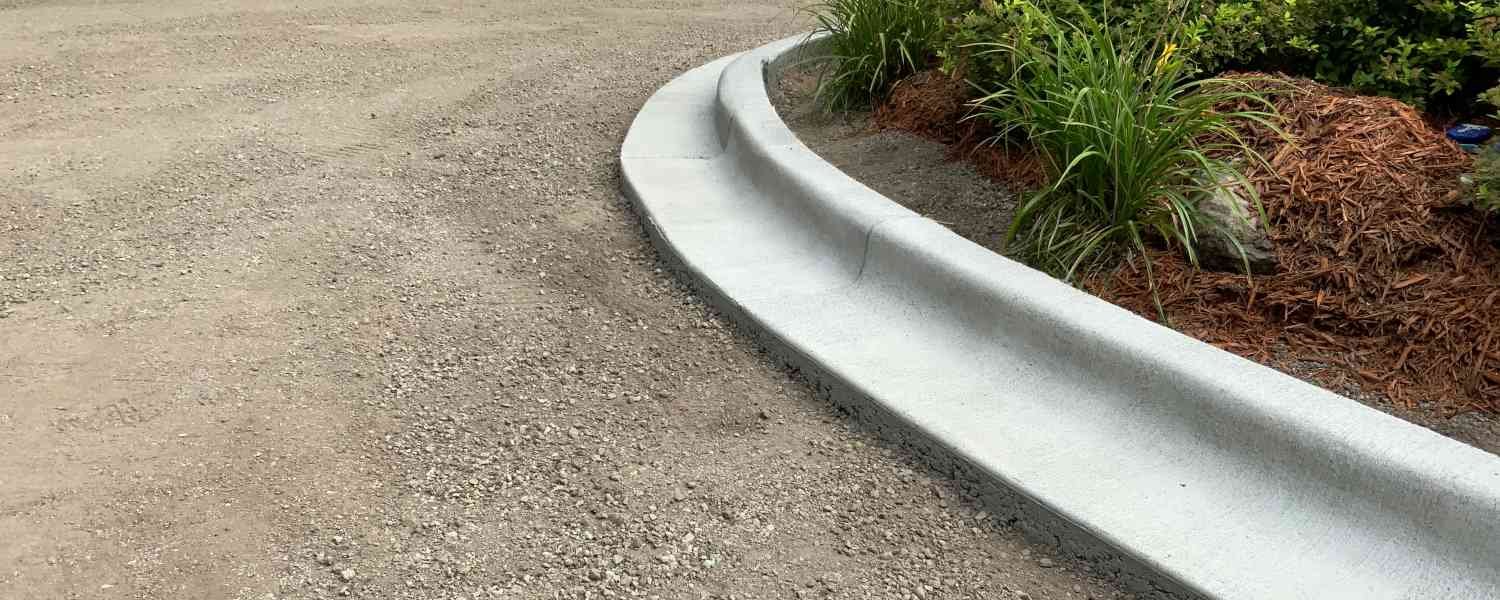
Curb and gutter is the concrete edge that holds the pavement, guides storm water into inlets and separates traffic from sidewalks and landscaping. It is a small section of concrete doing a big job, and it fails in a predictable way: the gutter holds a little water, the water softens the base, and the pavement edge breaks.
We build curb and gutter by machine on long runs and by hand on short ones, and in either case we are most concerned with grade. A gutter that is a quarter inch off the plan becomes a bird bath in front of a storefront. A slope we get right is a slope nobody remembers. That is the standard we work to, and it is why we check grade at every stake and not just at the ends of a run.
Grade first, then the form
We start from the survey stakes and set the line and grade with strings or a stringless machine reference. The base under the curb is compacted and trimmed to depth. On hand-formed work we set steel or wood forms, tie in dowels at joints, and place concrete in the section the engineer shows.
Slump is held to what the extruding machine or the form can handle, and finishing is done right behind the pour. Machine curb with too wet a mix slumps at the face and has to be hand finished, which wastes the speed that justified the machine. We cut contraction joints at spacing set by the plans, then cure and backfill behind the curb once the concrete has gained strength. In summer we cover the fresh curb against fast drying, and in a wet week we keep the base from turning to soup under the forms. Backfill that arrives too soon bows the curb, and we hold the line.
City standards and drainage review
Texarkana plans go through city review, and drainage is a major part of it. The comprehensive plan notes that floodplain areas are generally not able to be developed, and the Hazard Mitigation Plan lists Cowhorn Creek, between Summerhill Road and Robinson Road, among the impaired streams. Storm water has to reach inlets without overloading creeks that already carry too much.
Where a project is on a state route, TxDOT standards apply, and the inspector may be the state, not the city. The project page for US 82 near US 259 describes a new storm drain system with inlets and reconstruction of ramps, which is typical of how curb lines and inlets get planned together. We build to the standard shown on the drawings and coordinate inlet and manhole castings with the utility crew so the gutter falls to them correctly.
Curb types and related work
We place standard curb and gutter, mountable and rolled curb, valley gutter, ribbon curb and header curbs around islands and parking lots. Curb ramps, drive approaches and transitions to sidewalks and flatwork are formed as part of the same operation where possible, so the joints between curb and walk line up.
Related items include inlet tops, cleanouts, cross pans and concrete aprons at drive entrances. These are the detail areas where a rushed pour shows, so we give them the same attention as the long runs.
Sequencing around the paving
On a typical development, curb is poured after base preparation and before paving so the asphalt or concrete can be placed against it. That puts curb in the critical path for the pavers, which means a rain delay on the curb becomes a rain delay for everything behind it. We try to place curb in the first dry weeks of a job.
We also coordinate with the parking lot concrete crew where the curb is part of a larger paving package, and with the storm drain crew so the inlets are set and grouted before our forms are. Our storm drain installation scope is often the neighbor to the curb line.
What drives the price per foot
Machine-placed curb is cheaper per foot than hand-formed curb, but it needs a long straight run. Radius-heavy sites, islands and many small tie-ins push the job toward hand forms and a higher unit price. Mobilization of a machine is a fixed cost that is better spread over a larger footage.
Subgrade condition, access and the number of structures to work around also matter. A site with many inlets and manholes slows the crew down. We give owners a unit price and tell them which sections are likely to cost more, so the number is not a surprise. On a corridor job with many driveways, we also separate the price of driveway cuts from the straight runs, since each cut interrupts the machine and changes the labor.
Who builds curb with us
Developers laying out shopping centers and subdivisions rely on curb as the first visible layer of site work, and commercial developers often package it with the paving. Cities and districts that maintain streets buy it for replacement and extension.
For public clients, our municipal and public works experience tells us what inspectors look for. For commercial sites on corridors like the ones described on our Richmond Road and Summerhill Road page, we tie curb lines to driveway permits and access spacing. A shopping center on a five-lane arterial has to fit its curb cuts, turn lanes and sidewalks into a right of way that the city and TxDOT have already planned, and we read the permit before we draw the first line.
Send the plan sheets
Send the curb details and the grading plan. We will price by the foot, flag the sections that need hand work and tell you where we want the pour sequence to start.
Common Questions
What is the difference between curb and gutter and plain curb?
Curb and gutter is a combined section with a vertical or sloped curb and a gutter pan that carries water. Plain curb sits on pavement or a base and has no pan. The drawings show which to use, and we build to them.
How soon can backfill be placed behind a new curb?
After the concrete reaches enough strength to resist pressure, which can be a few days. Heavy equipment should wait longer. We tell the grading crew the earliest date and mark the work so nobody drives on it.
Can curb be placed in cold or wet weather?
We avoid pouring on a soaked base and protect concrete from freezing. Rain on fresh concrete can damage the surface, so we watch the forecast and cover the work if showers are possible.
Do you cut joints in curb?
Yes. Contraction joints are cut or tooled at the spacing shown, so cracks happen at joints. Expansion joints go at structures and where the curb meets rigid elements.
Who sets the line and grade?
The surveyor or engineer sets stakes, and we build to them. We check grades with a level as we go and report differences before they are poured into the work.