
Equipment Pads and Machine Foundations in Northeast Texas
Machine foundations, isolated pads and generator bases for depot, TexAmericas Center and industrial owners in Bowie County, built to vendor tolerance.
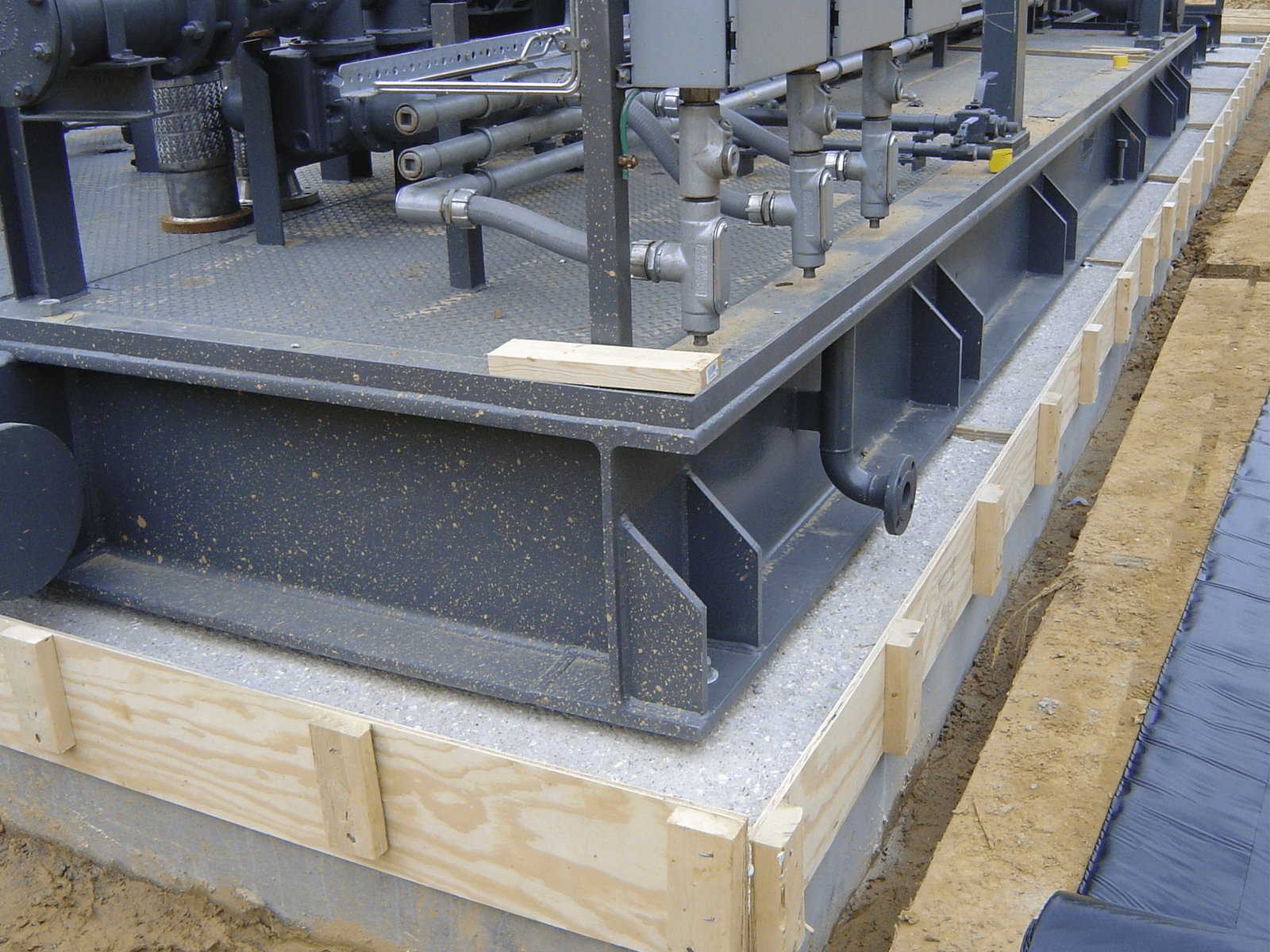
Automation equipment at Red River Army Depot is a contract worth $39.2 million in its first phase, with potential to reach $80 million and a completion date set for March 2027, according to local reporting on the award to Hadrian Automation. Machines like that do not sit on an ordinary warehouse slab. They need a foundation that holds alignment to a tight tolerance for years.
We build equipment pads and machine foundations for presses, CNC machining centers, compressors, generators, chillers, tank farms, conveyors and process skids. Some are a simple thickened slab with anchor bolts and grout. Others are isolated blocks, deep pits or inertia bases that must not carry vibration into the floor around them.
Whatever the machine, the pad starts as a conversation with the vendor drawings. We want the anchor bolt pattern, the weight and operating load, the vibration data and the grout requirements in hand before we draw a layout. Then we put the ground right, because a pad is only as good as what it sits on.
Owners who ask for machine foundations
Defense and manufacturing come first in this market. The Army describes Red River Army Depot as covering more than 15,000 acres with over 1,400 buildings, and DVIDS calls it the Center of Industrial and Technical Excellence for the Bradley Fighting Vehicle System. Sustainment work on tracked vehicles uses lifts, test stands and heavy machine tools, all of which need foundations that stay put. Industrial and manufacturing owners call us for the same reason.
Chemical and recycling operations at TexAmericas Center drive another line of work. COIM USA announced a $50 million expansion there, and Braven Environmental plans an advanced recycling facility with more than $145 million in capital investment. Process equipment of that kind sits on pads with curbs, drains and sometimes secondary containment. Oil, gas and midstream buyers add compressor skids and pump bases to the mix.
Pad types and what each one needs
A basic equipment pad is a thickened slab, reinforced top and bottom, with edge forms and embedded anchor bolts or sleeves. It suits generators, small compressors and light skids. A block foundation is deeper and heavier, with mass that resists the dynamic forces of a reciprocating machine. It often extends below the frost and moisture zone and sits on a lean concrete or compacted base.
An isolated foundation is separated from the surrounding floor by joint material so vibration from a stamping press or a large fan does not travel through the building. Pits come next, for machines that sit partly below floor level. Conveyor and rail supports, trench-fed utilities and cable trays all feed into the pad design. We build each one in its own sequence, and we coordinate rebar placement and embedded items with the machine installer, who usually has to approve the layout before concrete arrives.
The ground under the machine
Expansive clay is hard on precision. The USDA describes the Texark soil in Bowie County as a very fine clay, 60 to 80 percent clay, with cracks a quarter inch to two inches wide when dry and a water table at two to three and a half feet. A press pad that sits on that clay without preparation can tilt as the soil moves. Where the report calls for it, we over-excavate and replace with engineered fill, or we carry the pad on piers. The soil-treatment and over-excavation and recompaction work is planned before the forms go in.
Drainage and water matter too. A pad that traps water at the base of a machine will rust anchor bolts and break down grout. We slope the surface, set drip edges, and keep the pad surface above the surrounding floor where equipment spills could pool. If the site sits near the flood plain mapped in the city's hazard mitigation plan, we raise the pad elevation and talk to the engineer about flood-resistant design.
From layout to grout
We survey the bolt locations from the machine drawings and set them in a template that cannot shift during the pour. Anchor bolts in a pad are not forgiving. A bolt that is a half inch off may mean drilling and epoxy later, and for a precision machine it may mean a failed alignment. We set sleeves where the vendor allows and protect threads from wet concrete.
We place concrete in a controlled sequence, vibrate carefully around embeds and finish the top to a flat surface that the machine installer can level shims against. After curing, the pad is checked before grout goes in. Grout, whether cementitious or epoxy, is mixed and placed to the vendor's instructions, and we do not allow the machine to go on a pad that has not reached its design strength. Curing blankets protect the pad from sun and rapid drying so surface cracks do not telegraph into a grout pad.
Plans, loads and vendor requirements
Equipment pads are not always treated like building foundations. A small generator pad may need only a trade permit, while a heavy press foundation may be reviewed as structural work with calculations. In Texarkana, Texas the Inspections office lists the International Building Code as presently in use. The edition in force should be confirmed with the City. Outside city limits, a county permit may not be required, though Bowie County should be asked about septic and other specific items.
Vendor requirements often matter more than code. The machine maker will state a minimum compressive strength, allowable settlement, a flatness tolerance and a cure time before installation. We build those into the submittals and bring in concrete testing and quality control so the cylinder breaks and the surface checks are on record before the equipment arrives.
Matching the pad to the machine arrival
Equipment pads live on a schedule that is set by the machine, not the pour. The vendor delivers on a date, a rigging crew is booked, and the pad must be cured, checked and ready. We work backward from the delivery date, add time for curing and survey, and build in a cushion for rain. If a pour lands in a wet week, we cover and protect the concrete and keep the vendor informed.
On defense and process sites, access can slow the plan. Gate procedures, escort rules and work windows set by the owner all affect how many pours we can do in a week. We plan delivery routes for ready-mix trucks and pump equipment early and confirm them with the site contact, because a locked gate is as costly as a rain delay.
Send the machine drawings first
Give us the vendor foundation drawing, weight, bolt pattern and the geotechnical report. We will price the pad, embeds and cure, and tell you what the soil may require before we pour.
Common Questions
Can an existing slab carry new equipment?
Sometimes, but it should be checked. We look at slab thickness, reinforcing, subgrade and the loads the machine will apply. Heavy or vibrating equipment usually needs a new pad that is separated from the floor with an isolation joint. We can core or saw an opening in the existing floor and build a new pad inside it.
How long must a pad cure before the machine goes on?
It depends on the design strength the vendor requires, not on a fixed number of days. We break cylinders, and the machine goes on only when the results meet the specified strength. A cold or wet week can add days, so we plan a buffer.
What happens if an anchor bolt is placed wrong?
It can be fixed with core drilling and epoxy, but that adds cost and risk, and some vendors do not accept it. We prevent the problem by setting bolts in a rigid template and having the machine installer check them before the pour.
Do pads need isolation from the rest of the floor?
Machines with moving mass, such as presses and large compressors, generally need isolation so vibration does not damage the building. Light static equipment usually does not. The vendor drawings and the structural engineer will say which applies.
Can you build pads with curbs for spill control?
Yes. A curbed pad is a common detail for fluid-handling equipment. If the design calls for a full secondary containment area, it is treated as a separate scope with its own sealant, slope and sump details.