Concrete Testing and Quality Control in Texarkana, Texas
Concrete testing and quality control in Texarkana and Northeast Texas: subgrade proof rolls, slump, air and cylinders, flatness, curing records and closeout.
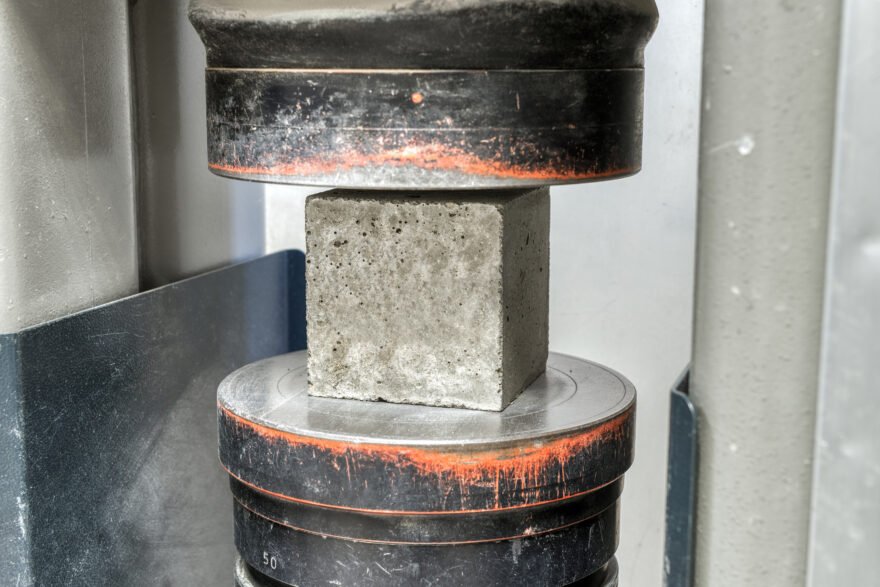
A cylinder break tells you what happened three weeks ago. A slump cone tells you what is happening right now. Quality control on a concrete job lives in the gap between those two moments, and the people who close that gap are the ones who catch trouble while it can still be fixed. We treat testing as part of the work, not a bill from someone else, and we want the results as much as the engineer does.
In Texarkana the stakes start in the ground. The USDA describes the Texark soil, with its type location in Bowie County near Dalby Springs, as a very-fine smectitic clay with 60 to 80 percent clay, slickensides at 12 to 20 inches, and cracks up to two inches wide when dry. Ground like that swells, shrinks and holds water, so a perfectly strong slab can still crack if the subgrade was not proven. Quality control here means checking the base before the concrete, not only the concrete itself.
This page explains what we test, who does it, how we handle the paperwork, and what we do when a number comes back wrong. If you are an owner, an engineer or a general contractor trying to understand what a good testing program looks like on a Northeast Texas job, this is the plan we follow.
What gets tested, and when
Before a pour, we look at subgrade density and moisture, reinforcement size and spacing, cover, form dimensions and embedded items. A proof roll with a loaded truck exposes soft spots that a nuclear gauge on a grid can miss. Fresh concrete is tested for slump, air content and temperature, and cylinders are cast for compressive strength at the ages the specification calls out.
After the pour, the program continues. Curing is monitored, flatness and levelness are measured on floors that carry a number, and cores are taken only when break results or visible defects call for them. For slabs with tight tolerances, such as those in super flat floor slabs, the floor profile readings come within hours, because the window to grind or correct is short.
Our role next to the testing agency
The agency is independent, and it should be. It reports to the owner and engineer, not to us. What we add is preparation: a clean sampling point at the end of the chute or pump hose, a place for the technician to set the cone and the air meter, shade for cylinders on a hot day, and a heated box in cold weather. A technician fighting for a spot on a muddy site writes a worse report.
We also keep a log. Truck ticket times, water added at the site, the pour sequence, ambient temperature and wind, and curing start times go in one record. When a break number comes back low, that record is what lets the engineer separate a bad batch from a sampling error or a curing lapse. Without it, everyone argues from memory.
Plans, accessibility and inspections
The City of Texarkana, Texas Inspections office at 220 Texas Blvd, Municipal Building, Room 301, reviews plans and posts the codes it enforces. The city page also states that plans must comply with the Texas Accessibility Standards and Texas Department of Licensing and Regulation requirements, and that is the state accessibility standard. We confirm the edition of the building code in force with the Inspections Department for each permit, because local adoption can change.
That matters for testing because the inspector and the special inspector may be looking at different things. The inspector checks work against the approved plans at stages like footings and reinforcement. The special inspector and the testing agency check materials. We schedule the building inspection before the pour and keep the material test plan alongside it, so one does not hold up the other.
Reading results on clay and in weather
Heat is the most common source of confusion. A hot day in Bowie County pushes concrete temperature up, shortens the time to set and raises early strength while lowering later strength. Cold shifts everything the other way. We talk to the engineer about acceptance criteria that fit the season, and our guidance for cold weather concrete includes temperature records tied to each load.
Clay affects what the numbers mean. A slab on a subgrade that was wet when the vapor barrier went down can show moisture issues months later, long after the cylinders passed. We pair strength testing with moisture checks of the subgrade and, when floor coverings are planned, with slab moisture tests before installation. Good strength alone does not promise a good floor.
Where a strong testing plan pays off
Clinics and outpatient buildings carry some of the tightest flatness, vibration and moisture demands, and the testing plan for a medical office floor is often more detailed than the structure itself. Schools and healthcare owners also tend to require third-party reports in a closeout binder, with every cylinder number traced to a pour location.
Industrial slabs get the heaviest scrutiny on flatness and joint performance, since forklifts expose every flaw. When restoration is needed on an older structure, our concrete repair and restoration work begins with testing as well: sounding, cover surveys and cores to see what the concrete is really doing before any repair is priced.
Owners who ask for a quality plan
Public owners and school districts usually write testing requirements into the contract, and they expect clean documentation. Schools and healthcare owners often add commissioning steps for floors and slabs that touch mechanical or clinical areas. We submit our quality plan with the bid so the evaluation compares like with like.
Private developers ask for something simpler: how will we know the floor is right before the tenant arrives? Our answer is an agreed list of test points, a short report after each pour, and an open line to the engineer. Across the broader site, our Bowie and Cass county site conditions notes explain why we recommend extra subgrade checks on clay.
Ask for our quality plan with your bid
Send the specification sections and the pour list. We will return a testing and quality plan that names who samples, who reports and how problems get resolved before they reach the slab.
Common Questions
Who pays for concrete testing on a commercial job?
The owner normally hires and pays the independent testing agency, and the contract says so. We pay for retests that result from our own failures and for any extra sampling we request. We settle this in writing before the first pour so no invoice is disputed later.
What do we do if cylinders break low?
First we check the paperwork: sampling, curing in the field, handling and the lab's break procedure. Then the engineer may order cores from the placement, or a review of the structural margin. Many low results trace back to cylinder handling, but we do not assume that, and we do not touch the concrete until the engineer decides.
Is a proof roll really needed if the geotechnical report is clean?
On Texarkana clay, yes. A boring report describes a few points. A proof roll covers the whole pad and shows soft areas between borings. The cost is a few hours of equipment and a technician, and the savings are in avoided cracking and repair.
How soon do we get test results?
Slump, air and temperature are read on the spot. Seven-day breaks give an early indication and the 28-day breaks are the ones that usually govern. Floor flatness numbers should come back within a day. We ask the agency to email results the same day so we can respond quickly.
Can we reduce testing to save money?
Cutting testing rarely saves anything. The cost is small compared with the pour, and a missing record makes any dispute harder to settle. What we can do is organize the program so tests are grouped by pour day, which trims mobilization fees without lowering the number of samples the specification requires.