
Containment Pads and Secondary Containment in Bowie County
Reinforced concrete containment pads, curbed dikes, sumps and truck loading pads for chemical, recycling and energy sites around Texarkana, Texas.
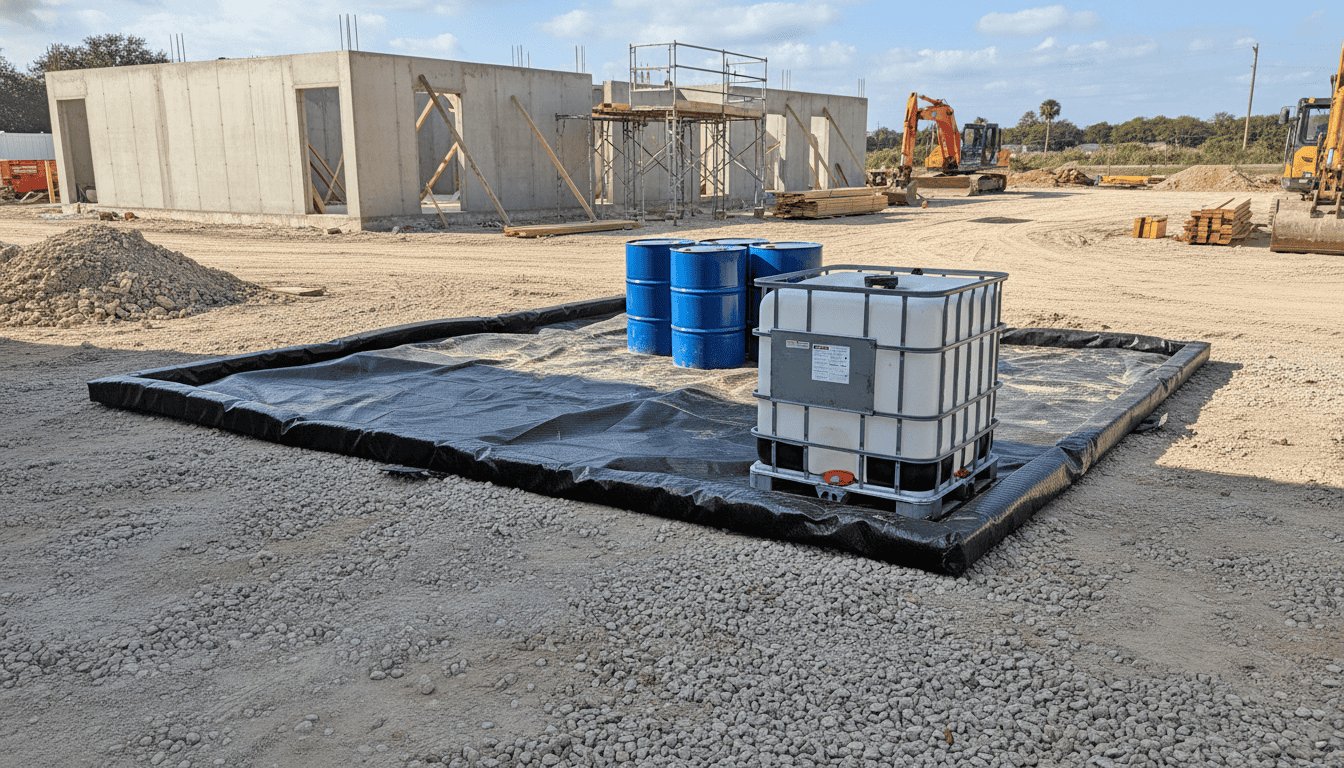
Rain that arrives at 42 to 58 inches a year does not stop at the edge of a chemical pad. The City of Texarkana hazard mitigation plan gives that range for the Piney Woods area, and any containment area that holds tanks, drums or process equipment has to deal with it every year, on top of whatever might leak from inside. A pad that holds fluid in dry weather but overtops in a storm is only half a pad.
We pour containment pads, curbed dikes, sumps, truck loading pads and secondary containment basins in reinforced concrete. These structures are expected to stay tight against water, fuel, glycol, caustic and many other liquids, and they are inspected for cracks and joints in a way that ordinary slabs never are. Every joint is a potential leak, and every crack is a path.
That is why we treat containment as a joint-and-cure problem first, and a concrete problem second. The mix, the steel and the finish matter, but the part that keeps a spill inside is what we do at the edges, the corners, the penetrations and the sumps.
Requirements that shape the design
Containment is governed by what is stored, not by one universal rule. Fuel, chemical and oil operations are regulated by state and federal agencies with specific size, volume and freeboard requirements, and the owner's environmental consultant usually supplies those numbers. We build to the drawings and to the sealant and coating manufacturer's instructions, and we ask early whether the design calls for rain cover, a drain valve, or a monitored sump.
Plan review for the building side still follows local rules. Texarkana, Texas lists the International Building Code on its inspections page. The edition in force should be confirmed with the City. Accessibility rules in the Texas Accessibility Standards can apply to routes into a facility even when the containment area itself is not public. Floodplain work needs a permit reviewed by the City Engineer, which matters on sites near mapped waterways.
Where containment work is coming from
The pipeline is chemical, recycling and defense. COIM USA announced an expansion at TexAmericas Center with a $50 million investment and about 100 million pounds of added annual capacity. Governor Abbott announced that Braven Environmental will open an advanced recycling facility there with more than $145 million in capital investment. Both involve liquids, rail-served storage and process areas where a dike or sump is not optional.
Rail matters because transload and storage often come with loading racks. The Texas Northeastern Railroad, whose line runs east from New Boston, serves the center with transload, storage and spotting. A rail-served facility has loading pads, drip pans and curbed dikes where tanker cars or trucks connect. Those are the places we pour with the most care, since a hose failure on a loading pad is a common source of spills.
The same needs appear in utilities and energy companies and oil, gas and midstream facilities across Bowie and Cass counties.
What a containment scope includes
The base is a reinforced slab, often thicker than a standard pad, sloped to a sump so water and spilled liquid collect where they can be pumped or inspected. Curbs rise around the perimeter at a height set by the volume that must be held. Sumps, pipe penetrations and valve boxes are formed in place. Joints get waterstops where the design calls for them and sealant where a flexible joint is allowed.
Truck unloading areas use a similar approach with a lower curb and a drive-over section. A manufacturing plant or process building adds a spill area at every chemical room door. Tank farms mix it with equipment pads and machine foundations under the tanks and pumps.
Many sites add trench drains to move stormwater away from the clean side. After the concrete is cured and tested, coatings or liners are applied by the specialist named in the drawings, and we coordinate access and surface preparation so that work goes on a clean, sound surface.
Working next to chemicals
Containment pads on operating sites mean working next to stored product, or in an area that is still being used. We follow the owner's permit-to-work procedures, wear the required protective gear and stay out of live lines. Before cutting or excavating, we locate utilities and check with the plant about buried piping, because a cut through a product line is a serious incident.
Concrete work has its own hazards. Wet concrete burns skin, rebar cages poke, and forms fall if they are not braced. Pump lines whip and trucks back up in tight yards. We hold a short safety talk before each pour, assign a spotter for trucks and keep walking routes clear of reinforcing. If a process area has to remain in service, we plan barriers and traffic lanes so the crew and the plant's operators do not meet in the same space unexpectedly.
Where containment costs come from
Joints and waterproofing are the cost drivers. A containment pad with waterstops at every joint, a coating and a monitored sump costs more than a plain slab, and a larger volume means taller walls and more steel. Site conditions also move the number. Blackland clay needs a stable base, and the USDA describes the Texark soil in Bowie County as a very fine clay with a water table at two to three and a half feet, so groundwater can be a concern for deep sumps.
Weather adds cost too. Rain on fresh concrete is a problem for a surface that must be tight, and we price curing blankets and covers for every pour. Testing is the other line item. Water-fill or flood tests are sometimes required before a coating, and they add time. We list all of these as separate items so a bidder who skipped them does not look cheaper than one who included them.
Bring us the storage plan
Send the tank layout, volumes and spill plan. We will price the pad, curbs, sumps and joint details, and tell you what we think the coating contractor will need from the concrete.
Common Questions
How thick should a containment slab be?
That comes from the engineer. Thickness depends on loads, soil and the number of joints, and many containment slabs are thicker than a standard industrial slab. We do not guess. We build to the drawings and raise questions if the soil report suggests settlement that would crack the pad.
Do containment pads need a coating?
Often, yes. Concrete is porous, and many liquids will pass through it over time. A chemical-resistant coating or liner is typically added after curing. The type depends on what is stored, and we prepare the surface as the coating manufacturer requires.
How do you handle rainwater inside a dike?
Most designs include a sump or a valve so accumulated water can be checked and released if clean. The slab slopes to that point. We pour with the slope as drawn and test it with water before handing it over. Where an old curb or slab has to come out first, the concrete demolition and removal trade crew clears it before new steel goes down.
Can containment be added to an existing tank area?
Yes, though it takes planning. We may need to saw cut, remove old slab and tie new work into the old with dowels and sealant. The existing tanks may need to stay in service, which affects how much area we can work at once.
What causes containment pads to leak?
Cracks at joints, poor consolidation around penetrations and sealant that was installed on a dirty or wet surface. Good forming, careful vibration and patient curing prevent most of these. Surface preparation before sealant is just as important as the concrete.