Mass Concrete Pours for Heavy Foundations in Northeast Texas
Thick mats, pile caps and heavy equipment foundations poured with thermal control, staged placement and temperature monitoring in Bowie County.
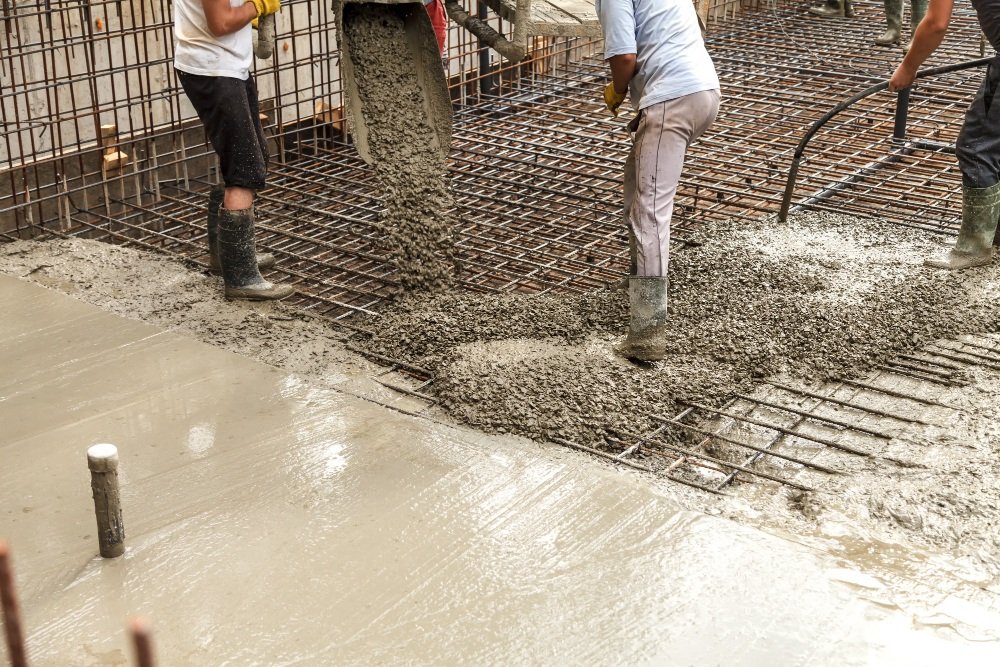
Heat builds inside a thick pour long after the trucks are gone. Cement reacts with water, the reaction gives off heat, and in a block of concrete several feet thick that heat cannot escape quickly. The middle gets hot, the surface stays cooler, and the difference can crack the concrete from the inside out.
That is the problem with mass concrete, and it is why we treat any pour that is thick, heavy or large in volume as its own category of work. We place heavy foundations, thick mats, pump station bases, large caps over drilled piers, equipment blocks and transfer slabs where the thickness, not the area, is the hard part. A mat that is six feet deep behaves nothing like a six-inch slab.
Northeast Texas is seeing more of this kind of work as large industrial and power-intensive projects come to the area. We bring the planning that thick placements need: thermal control, staged placement, careful mix design, temperature monitoring and a curing plan that lasts as long as the heat does.
Where thick pours are coming from
TexAmericas Center and Potentia Development announced Project Big Pine in April 2026, a planned 500-acre data center and power-intensive campus in Bowie County with an estimated $3.5 billion in projected investment and a target of 24 to 30 months to energize. Other outlets cite 400 or 450 acres, so we treat the acreage as approximate. Campuses like that carry generators, switchgear, cooling plant and transformer pads, many of which sit on mats that qualify as mass concrete. The announcement also notes a nearby 345-kV transmission line.
The industrial base adds more. COIM USA's expansion of its rail-served specialty chemical site and Braven Environmental's advanced recycling facility, both at the same park, involve heavy process foundations. Owners in utilities and energy rely on us for the same class of work, and data center developers are the newest group asking about it.
Heat, shrinkage and size
The core of a mass pour can reach temperatures far above the surface, and if the difference between the two grows too large, thermal cracks open. Guidelines often cap peak temperature and the temperature difference, and the engineer will set limits for the project. In a hot Texas summer, the starting temperature of the concrete matters too. The Texas Almanac lists a July mean maximum of 92.9 degrees Fahrenheit in Bowie County, so a mix that arrives warm starts the pour behind.
Restraint is the second concern. Concrete placed against hardened concrete or rock cannot shrink freely, so it cracks. We plan pour sequences with this in mind, use construction joints where permitted and consider the subgrade. Soil also matters. The USDA describes clay soils in Bowie County, like the Texark series, as very fine clays with slow permeability, so a base for a thick mat needs to be prepared and drained properly. Engineered fill and soil stabilization is often the first step.
Mix design and monitoring requirements
Mass concrete is usually spelled out in the specifications with maximum temperature, maximum differential, pour size limits and curing durations. A thermal control plan is submitted before the pour, often with a prediction of peak temperature from the mix and the placement conditions. We work with the concrete supplier on a mix that uses supplementary cementitious materials to reduce heat, a lower water content and sometimes ice or chilled water.
Monitoring is done with embedded sensors that record temperature at the core and near the surface throughout the cure. Readings are logged and shared with the engineer. In Texarkana, Texas, the city's Inspections office reviews the permit set, and the inspector may want to see the thermal plan with it. Special inspection and concrete testing and quality control cover cylinders, slump and temperature at the truck.
How we place a large block
The first step is logistics. A mass pour may take many hours and hundreds of truckloads, and the supply has to be continuous. We schedule batch plant capacity, truck spacing and pump sets, and we confirm backup plants. A stalled pour makes a cold joint that can weaken the mass.
We place in layers so each lift covers the previous one before it sets, vibrate each layer into the one below and finish without overworking the surface. Curing begins right away, with insulation blankets to slow surface cooling and keep the temperature difference within limits. In this region, we also protect against rain, which can wash the surface or pond in low spots. A pump line gets moved and cleaned on a schedule, and concrete pumping and placement is planned as part of the same logistics plan. The mat is reinforced to the engineer's drawing, and rebar chairs are heavy-duty to carry the load of the concrete.
Time, temperature and the clock
Mass pours are best done at night or in the early morning in summer, when ambient temperatures are lower and the concrete starts cooler. That means night work, lighting and noise permits. In winter, the concern flips, since cold ground and air can pull heat from the surface. Curing is long, often several days to weeks before blankets can come off, and monitoring continues the entire time.
For a program like Project Big Pine, with a target of 24 to 30 months to energize the campus, foundations occur early and set the pace for everything that follows. The same is true of a pump station or a plant. Get the thick pours right the first time, because repairing a cracked mass pour is slow and expensive. Early engagement with the concrete team helps a project manager place a realistic duration into the master schedule.
Big pours, big hazards
Large pours involve many people, heavy equipment and long hours. We hold a pre-pour meeting with all parties, assign roles for trucks, pump, vibrators and finishers, and set traffic lanes. Fatigue is a real hazard on a long pour, so we rotate crews and plan breaks and relief.
Open excavations, edge forms and deep mats are fall hazards, and we protect them with covers or rails. Concrete burns, hot weather illness and lighting at night all get attention. Pump lines can kick when pressure releases, so we keep people away from hose ends and couplings. Lifting heavy chairs and rebar cages also requires lift plans and trained riggers.
Plan thick pours early
Give us the foundation drawings and the specification. We will review pour size, thermal limits and logistics and give you a plan and price before the schedule hardens.
Common Questions
How thick does a pour need to be to count as mass concrete?
There is no single number, and the project specification defines it. The idea is that the block is large enough that heat from cement hydration can cause damaging temperature differences. Many specifications start considering it around three to four feet of least dimension.
Why do mass pours crack?
Because the inside heats up while the outside cools, creating stress. Restraint from adjacent concrete or soil adds to it. Mix design, placement temperature, insulation and sequencing all reduce the risk.
Can you pour mass concrete in summer?
Yes, with controls. We schedule pours for cooler hours, ask the supplier to use cooled materials, and shade or insulate as needed. Bowie County summers average a July maximum near 93 degrees, so hot-weather planning is normal here.
How is temperature monitored?
Sensors are embedded in the core and near the surface, and temperatures are logged. The data goes to the engineer, and blankets or other controls are adjusted if limits are approached.