Concrete Leveling and Slab Lifting in Northeast Texas
Lift and level sunken sidewalks, aprons, garage floors and warehouse slabs on Bowie and Cass county clay with foam or grout, after finding the cause.
Slabs that rock under a foot are one of the quieter signs that clay has moved. A garage apron tilts toward the door, a warehouse aisle steps up at a joint, a sidewalk panel drops an inch below its neighbor. Most of the time the concrete is fine and the ground under it has changed.
The USDA describes the Texark soil, whose type location is in Bowie County near Dalby Springs, as a very fine clay with 60 to 80 percent clay and cracks a quarter inch to two inches wide, extending more than 20 inches deep when dry. That kind of soil opens up in a dry summer and swells shut in a wet spring, and it does not do this evenly. Slabs ride on top of it and follow it.
We lift and level sunken concrete rather than tearing it out, where the slab itself is still good. It costs less, finishes faster and leaves the existing joints and reinforcing in place. It does not suit every slab, and we say when it does not.
When lifting works and when it does not
Lifting is a good fit when a slab is intact, uniformly thick and has dropped because the ground under it settled, compacted or washed out. It is a poor fit when the slab is shattered, when the base is still moving, or when the cause is still active, such as a leaking pipe or a downspout dumping water beside the foundation. Lifting a slab on a base that continues to erode only resets the clock.
So we start with a diagnosis. We probe the voids, check drainage, look for plumbing leaks and read the cracks. Is the slab sinking at one corner or all along an edge? Is it near a roof drip line or a tree? In Bowie and Cass counties, with annual rainfall near 50 inches and a July mean maximum temperature of roughly 92 degrees according to the Texas Almanac, the swing between wet and dry is large, and we ask the owner what happened in the last wet and dry seasons before choosing a fix.
Methods we use
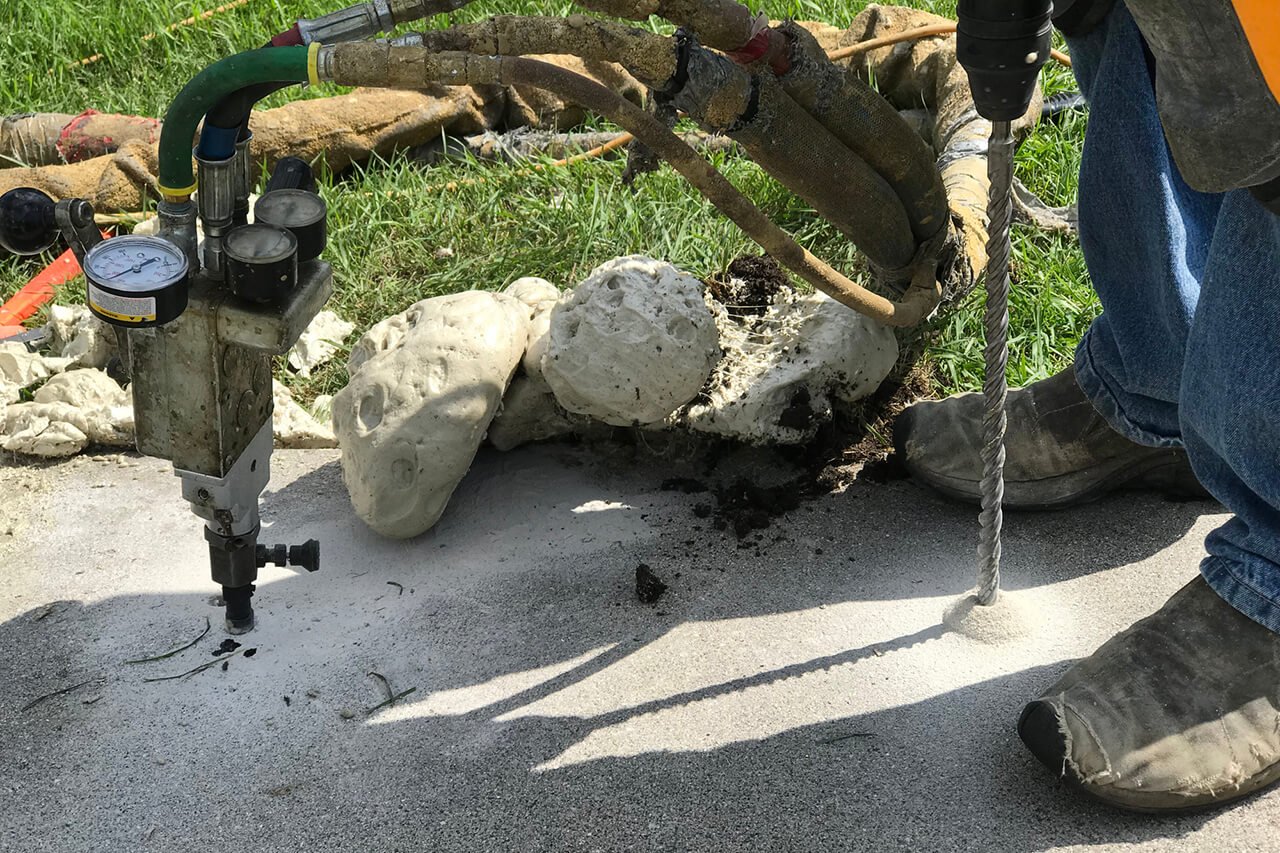
Two systems are common. Polyurethane foam is injected through small holes drilled in the slab, expands into voids and lifts the panel as it cures. It is lightweight, which matters on weak soils. Cementitious grout, often called mudjacking, is pumped through larger holes, fills voids and raises the slab with weight and pressure. It is heavier but costs less and suits some heavy-duty uses.
We choose between them by the soil, the void size, the load and the budget. Foam is common for sidewalks, garage floors and interior slabs, and for places where the extra weight of grout would sink further. Grout works for large voids under driveways and aprons. Smaller work includes shaving trip hazards at a joint, which is a grinding task and not a lift. Where a slab is beyond saving, we move to demolition and removal and replace it with new sidewalks and flatwork.
What decides the price
Leveling is priced by the number of injection points, the volume of material, the area of the slab and the ease of access. A small sidewalk panel may be a short visit. A large warehouse aisle or dock apron needs more holes, more material and traffic control. Foam costs more per cubic foot than grout but may need less material.
The cause of the settlement also moves the number. If a fix needs a drainage change, a new downspout extension or a trench to carry water away from the slab, those are added costs. Comparing leveling to replacement is where owners often save the most. A lifted slab keeps its existing reinforcing and joints, and a lifted floor in an operating building may avoid weeks of shutdown. We provide both prices when the slab could go either way, and we are honest that replacement is sometimes the better value.
Lift in small steps and check as we go
We drill small holes, usually in a grid, then inject material in stages. A slab raised too fast cracks, and a slab that is lifted past level is hard to bring back. We watch with laser levels, move from low points to high ones and stop when the surface is where it should be. Holes are patched and sealed once the material has cured.
Afterward, we look at what caused the settlement and work with the owner on the next step. That may be regrading so water runs away from the slab, adding a gutter extension or filling a void with a flowable fill. Where a slab is part of a longer drainage system, a trench drain or a swale may be called for, and we handle that through trench drains and concrete drainage.
Where we level and lift
We lift slabs across Bowie and Cass counties: parking areas and sidewalks in Texarkana, warehouse aprons near the industrial areas, and municipal flatwork in smaller towns.
Homebuilders and multifamily developers call us for porches, driveways and patios that have settled, and municipal and public works offices call about sidewalk trip hazards, a recurring liability for any city.
Clay is not uniform, and neither is the work. The Billyhaw series, with its type location in New Boston, sits on Red River flood plains and is also a very fine clay, so settlement problems look similar across the area. A site visit is the quickest way to tell whether your slab is a good candidate for lifting.
Have us look at the low spot
Describe where the slab has dropped and send a photo. We will visit, probe the voids and tell you whether lifting is a sound choice or whether the slab should be replaced.
Common Questions
How long before I can use the slab after lifting?
Foam sets quickly, often within minutes, so foot traffic and light vehicles can return soon after. Grout takes longer to gain strength. We give you a specific wait time based on the material and the load.
Will the slab sink again?
It can, if the cause is still active. Settlement from compaction usually does not repeat once voids are filled. Settlement from a leaking pipe, poor drainage or soil shrinkage can return. We look for the cause and recommend fixes so the lift lasts.
Is slab lifting cheaper than replacement?
Often, yes, particularly for large slabs with sound concrete. The savings come from avoiding demolition, haul-off, new forms and new concrete. If a slab is cracked in many pieces, replacement may be the better choice and we will say so.
Can you lift slabs inside an operating building?
Yes. Foam injection uses small holes and little equipment, and it creates little dust compared with demolition. We plan work around forklift traffic and shifts, and we can section off aisles to keep the building running.
What about cracks that open again after repair?
Active cracks move with the soil. A rigid fill will break again, so we use flexible sealants for moving cracks and reserve rigid repairs for stable ones. We explain which type applies before work starts.