
Fine Grading in Texarkana, Texas
Finish grade, tolerance control and drainage slopes for slabs, paving and building pads in Texarkana, planned around red clay, rain and proof-roll testing.
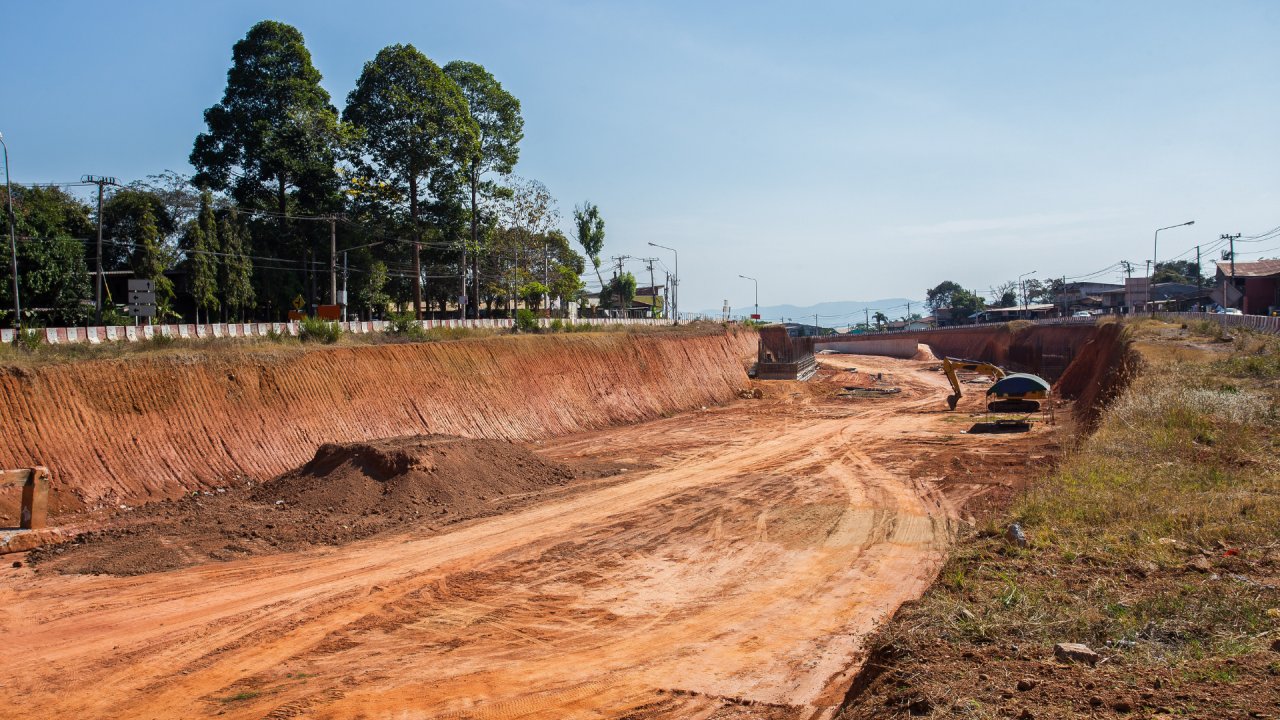
A slab does not care how good the mass grading looked. It cares whether the last four inches of subgrade are flat, firm and the same thickness from one corner of the pour to the other. Fine grading is where we settle that, and on most jobs in this part of Bowie County it decides whether the concrete behaves for twenty years or starts telling stories in the second winter.
We run fine grading as its own pass with its own tolerance, not as a sweep at the end of the dirt work. The crew arrives after the rough grade has been tested, trims to elevation with grade stakes or machine control, and leaves a surface that the paving or slab crew can walk without building up thickness in the low spots. Thin spots crack. Thick spots cost cement. Both are avoidable.
Our customers are general contractors, industrial owners and developers who want a surface that passes inspection the first time. That means knowing what red clay does when a thunderstorm sits over the site overnight, and having a plan for it before the weather forecast gets bad.
What a finish grade pass includes
The work starts with checking the rough grade against the plans. We shoot elevations on a grid, mark cut and fill to the tenth of a foot, and flag any area where the base is more than a few tenths out so it can be corrected before stone or sand goes on top. Catching a high spot in the clay is cheap. Catching it after the stone is spread is not.
From there we trim the subgrade to the slab or pavement elevation, shape drainage slopes toward inlets, swales and curb lines, and prepare the surface for stone base, vapor retarder or direct placement depending on the design. On building pads we also cut out and tidy around footing lines, thickened edges and utility sleeves, so the formwork crew finds a clean surface rather than a rutted one.
Finish grading also covers the soft areas that always appear after rain. We probe, mark and report them. If the soil is pumping under a loaded truck, we do not smooth it over and hope. We stop, document it, and the owner's engineer decides whether to dry it, undercut it or treat it.
Why we grade last and grade twice
Subgrade conditions change by the day in Northeast Texas. The Texarkana hazard mitigation plan puts average rainfall in the Piney Woods area at 42 to 58 inches a year, and the red clays in areas of redlands hold that water longer than the sandy loams on top of them. A pad that proof rolled clean on Tuesday can be rutted again on Friday.
So we do not trim finish grade until the pour or the paving date is close. When the schedule allows, we rough in the surface, seal it with a smooth drum roller when rain is coming so water runs off rather than soaks in, and come back for the final trim a day or two before concrete arrives. That second pass takes less time than the first and costs far less than redoing a saturated pad.
Grade control matters more than most people expect. We work from the engineer's control points, check against a second benchmark before each shift and recheck after any equipment move that could have bumped a stake. When a site has machine control, we still verify by hand at intervals. Technology helps, and a string line still catches the error nobody expected.
Work that happens before and after the final trim
Fine grading only works when the earlier steps were done well. Most of our customers pair it with building pad preparation, where the sequence of lime, compaction and proof rolling gets finished before the last trim. For parking fields and truck courts the same logic carries over to asphalt paving base preparation, where a smooth, tight base is what keeps the surface course from ravelling.
After the trim, the next step is usually placement. On slabs that means slab on grade work, where we coordinate vapor barrier, edge forms and reinforcing in the same window. On flatwork it means sidewalks and flatwork and the accessible routes that tie them to buildings and parking, which have slope limits that fine grading must respect to the fraction of an inch.
Tolerances, testing and the local review picture
Tolerances come from the project specification and the geotechnical report, not from us. A common slab-on-grade requirement is a subgrade within a few hundredths of a foot of plan, with a stone base trimmed even tighter. We build to what the documents say and report what we find. If the grades on the drawings will not drain, we raise it early, not in the closeout.
Permitting in the city of Texarkana runs through the Inspections office at the Municipal Building, and plans have to comply with the Texas Accessibility Standards administered by the Texas Department of Licensing and Regulation. That matters for fine grading because sidewalk cross slopes, ramp landings and parking-stall slopes are checked against those standards. The city's page lists the International Building Code as presently in use. The edition in force should be confirmed with the City.
Bowie County does not appear to issue general building permits, so a site inside Nash, Wake Village or another city answers to that city, and unincorporated land should be confirmed with the county. Floodplain permits within the city limits go through the City Engineer, a point that decides grading limits on creek-side lots.
What moves the price of a trim
Fine grading is priced by area and tolerance, and then adjusted for conditions. A large open pad on dry ground in August is a different job than a tight parking lot with islands in a wet March. Weather delay days, remobilization after rain and rework of softened areas are the real swing factors, and we say so in the proposal instead of burying them in a lump sum.
Tolerance is the other driver. A distribution center shows why: the 150,000 square foot multitenant spec building completed at TexAmericas Center, with 32 foot clear height and a dock door for every 5,000 square feet, puts its tightest tolerances on the dock aprons and floor, and those take more passes and more survey time than a typical sidewalk subgrade. Developers building for logistics and warehouse tenants tend to ask for the tight version, and we price it honestly. Tell us the finished use of the surface and we will price the right tolerance, not the most expensive one.
Timing the trim to the pour
The best-run jobs treat fine grading as the hinge between the dirt crew and the concrete crew. We book it two to three days ahead of the pour when forecasts are clean, and move up or back as the weather changes. A call to the batch plant is easy to adjust. A call to a pump truck operator is harder.
We also coordinate with testing. Proof-roll results, density tests and moisture checks are scheduled so that the engineer's technician sees the final surface, not an earlier version. If the surface has to be rechecked after rain, the grading trade partners and equipment are scheduled to correct what the test finds.
Send us the plans and the soils report
We will price the trim, the tolerance and the weather allowance separately so you can see where the money goes. Call or send a quote request with the drawings and a target pour date.
Common Questions
How close to the pour should the final trim happen?
As close as the weather and schedule allow, ideally within a day or two. Red clay softens quickly under rain and traffic, and a surface that was perfect on Monday can have ruts by Thursday. We plan the final pass tied to the confirmed pour date and sealed with a roller when rain is forecast.
Can you grade to laser or GPS control?
Yes, we work from the engineer's control points and use grade stakes and machine control where the job has the data to support it. We still check by hand at intervals, because an equipment bump or a misread file shows up sooner with a string line than with a screen.
What happens if the subgrade is pumping or soft?
We stop, mark the area and notify the engineer or testing agency. The usual remedies are drying and recompaction, undercutting and replacement with approved fill, or soil treatment, which are covered under our over-excavation and lime work. We do not trim over a soft spot, because the slab above it will tell on us later.
Do you do sidewalk and ramp grading to accessibility rules?
Yes. Accessible routes, ramps and landings are held to slope limits from the Texas Accessibility Standards, so we trim those areas with a digital level and check them before forms go in. Fixing a half-percent error in subgrade is a lot cheaper than demolishing a finished ramp.
How is fine grading priced?
By square footage and required tolerance, with allowances for weather and rework identified up front. Open pads on good access cost less per foot than tight parking lots with islands and utilities. Send us the plans and the soils report and we will separate the base price from the weather-driven items.